


What if the most effective way to restore your mobility wasn’t found within the walls of a sterile clinic, but through a precision-engineered medical intervention delivered directly to your home? You likely understand that chronic leg sores aren’t just a physical burden; they’re a logistical one. Between the 45 minute crawl through Los Angeles traffic and the complexity of distinguishing between various circulatory issues, managing your recovery can feel like a full-time job. It’s exhausting to balance frequent debridement appointments with the reality of painful, limited movement. This is why specialized venous & arterial ulcer treatment must evolve to meet the needs of your lifestyle.
We’re here to bridge that gap and optimize your recovery. This guide explores how our mobile medical service integrates regenerative medicine and advanced diagnostic biomarkers to accelerate your healing journey in Glendale and the surrounding areas. You’ll discover how a 360-degree approach to vascular health can reduce localized swelling by approximately 40% within the initial treatment phase. We’ll outline how our integrative methodology significantly lowers the 15% risk of amputation often associated with untreated chronic wounds, providing a clear roadmap toward peak performance and long-term longevity.
Key Takeaways
- Identify the critical physiological differences between circulation ‘return’ and ‘delivery’ to ensure your treatment plan addresses the specific root cause of non-healing leg ulcers.
- Learn why standard bandages often fail and how breaking the inflammatory “Chronic Wound Cycle” is essential for restoring skin integrity and long-term vitality.
- Access specialized venous & arterial ulcer treatment directly at your bedside, utilizing advanced vascular diagnostics to bring the expertise of a clinical lab into your home.
- Explore the transformative potential of regenerative medicine, including bio-engineered skin substitutes and amniotic grafts that harness biological factors for rapid healing.
- Discover how a coordinated, mobile recovery plan optimizes your health journey by bridging the gap between cutting-edge clinical science and your daily quality of life.
Understanding Leg Ulcers: Venous vs. Arterial Identification
Your vascular system operates as a sophisticated, closed-loop network of delivery and return. When this loop experiences a mechanical or structural failure, the skin serves as the primary canvas for these internal disruptions. Effective venous & arterial ulcer treatment begins with a precise 360-degree assessment of your circulatory health. We don’t just see a wound; we see a map of your vascular architecture that requires optimization to restore your peak physical performance.
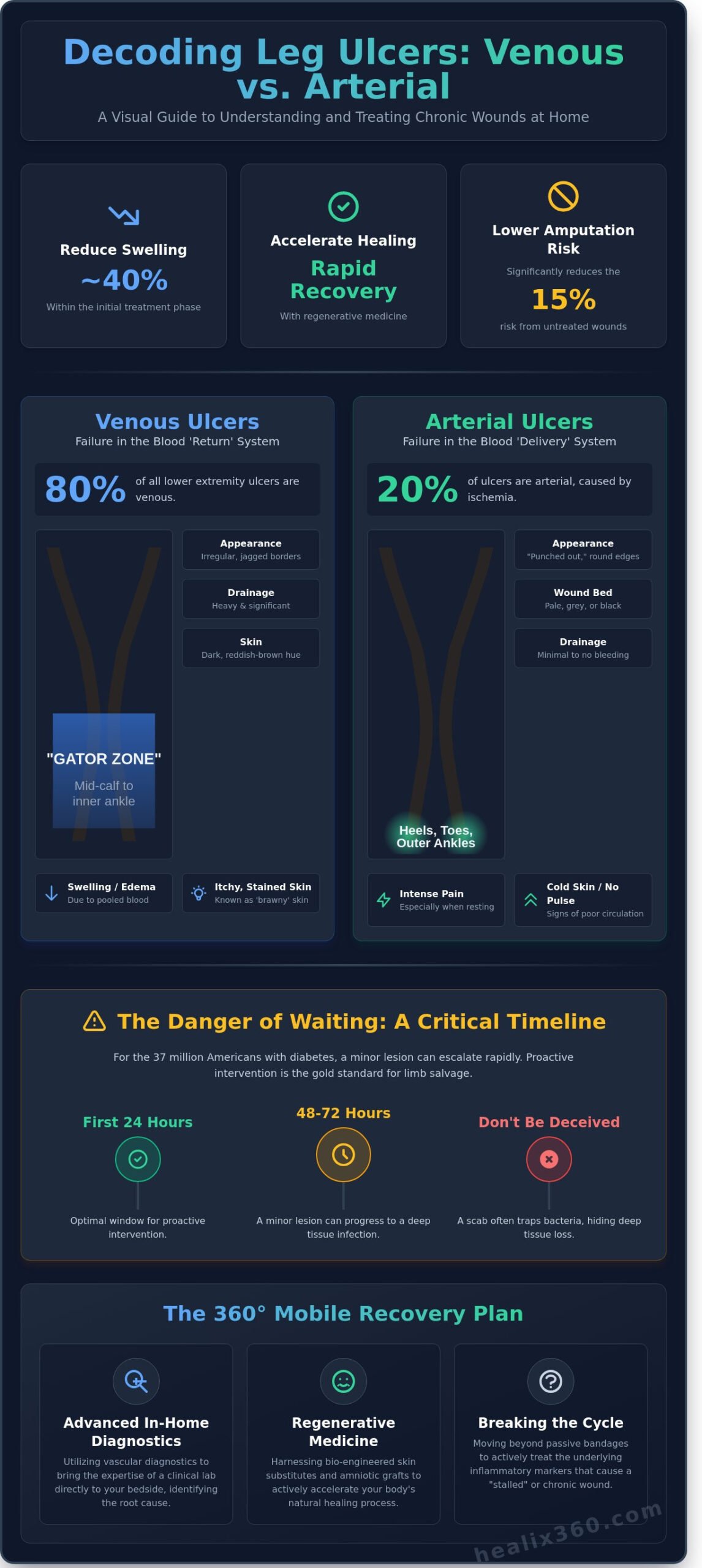
In Glendale, where 17 percent of our 196,000 residents are over the age of 65, chronic wounds represent a significant barrier to longevity and active living. Identifying the root cause of a leg ulcer is the first step in an integrative care plan. Venous ulcers typically stem from a failure in the “return” system, where blood pools in the lower extremities due to weakened valves. Arterial ulcers occur when the “delivery” system fails to transport oxygen-rich blood to the tissues, often due to plaque buildup or narrowed vessels. This distinction is critical because the interventions for one can sometimes be detrimental to the other.
Waiting for a wound to “scab over” is a common but dangerous misconception that places elderly and diabetic patients at extreme risk. For the 37 million Americans living with diabetes, a minor lesion can progress to a deep tissue infection within 48 to 72 hours. A scab often acts as a deceptive lid, trapping bacteria and hiding the true depth of tissue loss. Proactive intervention within the first 24 hours of noticing a non-healing break in the skin is the gold standard for limb salvage and long-term wellness.
Venous Stasis Ulcers: The Result of Poor Return
Venous ulcers account for approximately 80 percent of all lower extremity wounds. These typically manifest in the “gator zone,” which is the region extending from the mid-calf down to the medial malleolus, or inner ankle bone. A venous ulcer is often characterized by irregular, jagged borders and a shallow wound bed that produces significant drainage. You may notice “brawny” skin discoloration, where the lower leg takes on a dark, reddish-brown hue due to iron deposits from trapped blood cells. Southern California’s climate plays a direct role here; Glendale’s summer temperatures, which frequently exceed 92 degrees Fahrenheit, cause blood vessels to dilate. This heat increases venous pressure and exacerbates edema, making professional management essential during peak temperature months.
Arterial Ulcers: When Blood Flow Fails
Arterial ulcers are the result of ischemia, where the lack of oxygenated blood causes tissue death. These wounds possess a distinct “punched out” appearance, featuring perfectly round edges and a pale, grey, or even black wound bed. Unlike venous wounds, arterial ulcers are often found on the toes, heels, or outer ankles. They’re notoriously painful, especially when you’re resting or when your legs are elevated. Because elevation further restricts blood flow, patients often find relief by dangling their feet over the side of the bed. If you notice cold toes, a blue tint to the skin, or the absence of a pulse near the wound site, it constitutes a medical emergency. Rapid venous & arterial ulcer treatment is the only way to restore the biomarkers of healthy circulation and prevent irreversible tissue loss.
- Venous Signs: Heavy drainage, swelling, inner ankle location, itchy skin.
- Arterial Signs: Intense pain, cold skin, “punched out” shape, minimal bleeding.
- Risk Factors: Age 65+, history of smoking, diabetes, or high blood pressure.
The Science of Non-Healing: Why Standard Bandages Fail
Healing is a complex biological symphony that requires precise orchestration of cellular signals and nutrient delivery. When this process is interrupted, the wound enters a “stalled” state known as the chronic wound cycle. Standard bandages often fail because they are passive barriers rather than active therapeutic tools. They don’t address the underlying inflammatory markers or the microscopic ecosystem that prevents tissue regeneration. In the Glendale area, where temperatures can fluctuate significantly, managing the wound microenvironment becomes even more critical for successful venous & arterial ulcer treatment.
The pathophysiology of these wounds differs based on the vascular origin. Venous hypertension occurs when damaged valves allow blood to pool in the lower extremities, creating high-pressure zones that leak fluid into the surrounding tissue. This fluid contains metabolic waste that degrades the skin’s integrity from the inside out. Conversely, arterial disease creates ischemia, a condition where the lack of oxygenated blood starves cells of the energy required for repair. Understanding venous ulcer causes and treatments is vital because it highlights why a simple dressing cannot fix a systemic circulatory failure. At Healix360, we view these wounds as biomarkers of internal vascular health that require a 360-degree diagnostic approach.
Biofilms and Bacterial Load
Biofilms are sophisticated microbial communities that adhere to the wound bed, protected by a self-produced extracellular matrix. Research indicates that nearly 80% of chronic wounds harbor these invisible structures, which act as a shield against standard topical creams and the body’s immune response. A biofilm can reform within a 24-hour cycle, making consistent intervention necessary. Healix360 specialists utilize sharp debridement to physically disrupt these colonies and remove necrotic tissue. By performing bedside debridement, we reset the wound’s biological clock, shifting it from a stagnant, chronic state back into an active, healing phase. This process is a cornerstone of effective venous & arterial ulcer treatment, ensuring that advanced biologics can actually reach the healthy tissue beneath the surface.
The Role of Edema in Venous Disease
Edema is not merely a symptom of leg swelling; it is a physical barrier to oxygen delivery. Excess fluid in the interstitial space increases the distance oxygen molecules must travel from the capillaries to the skin cells, effectively suffocating the wound. In Southern California’s climate, heat-induced vasodilation can increase localized swelling by as much as 15% during peak summer months, further compromising skin health. We address this through a structured and intentional arrangement of care:
- Diagnostic Assessment: Measuring the exact degree of fluid retention to tailor the intervention.
- Compression Therapy: Utilizing localized compression, typically between 30 and 40 mmHg, to facilitate venous return.
- Micro-environmental Control: Managing moisture levels to prevent skin maceration and breakdown.
Compression remains the gold standard because it mechanically assists the calf muscle pump, reducing the internal pressure that causes the ulcer to form. You can explore our integrative recovery plans to see how we combine these clinical standards with cutting-edge technology to restore your mobility and vitality.
Our approach at Healix360 focuses on longevity and optimization. We don’t just treat the surface; we architect a roadmap for cellular recovery. By identifying the specific barriers to healing, whether they are bacterial biofilms or ischemic deficits, we provide a level of precision that standard clinical environments often overlook. This data-driven methodology ensures that every patient receives a personalized strategy designed for peak performance and long-term tissue health.
Advanced Diagnostics and Bedside Assessments
Precision is the cornerstone of the Healix360 philosophy. We’ve reimagined the diagnostic process by bringing the full capabilities of a vascular lab directly to your bedside. This eliminates the 7 to 14-day waiting periods often associated with traditional Glendale imaging centers. By utilizing portable, high-definition technology, we capture real-time data on your circulatory health within the comfort of your home. This immediate access to clinical insights allows us to initiate venous & arterial ulcer treatment without the delays that often lead to wound deterioration.
Our diagnostic protocol isn’t just about convenience; it’s about safety and scientific rigor. We perform comprehensive wound culture and sensitivity testing on every initial visit. Data shows that roughly 60% of chronic ulcers harbor complex biofilms or multi-drug resistant organisms. By identifying the exact pathogen through molecular analysis, we replace broad-spectrum guesses with targeted, effective interventions. This data-driven approach ensures your recovery plan is built on a foundation of biological certainty rather than trial and error.
Mobile Vascular Screening in L.A. County
Healing requires a clear map of the body’s delivery system. Our mobile screening units evaluate blood flow dynamics to identify Peripheral Artery Disease (PAD), a condition present in nearly 20% of adults over age 65. We never apply high-pressure compression without first confirming arterial patency. The Ankle-Brachial Index (ABI) is a diagnostic tool used to measure the ratio of blood pressure at the ankle to the arm. A reading below 0.9 indicates arterial insufficiency, while a result under 0.5 signals severe ischemia that requires an immediate shift in the clinical roadmap to prevent tissue loss.
Assessing Wound Tissue Quality
Our board-certified specialists conduct a granular analysis of the wound bed to determine its regenerative potential. We carefully differentiate between yellow slough, black necrotic eschar, and the vibrant red of healthy granulation tissue. If a wound fails to show a 50% reduction in size over a 4-week period, we introduce advanced biological triggers. This often involves the integration of regenerative cell therapy to stimulate the body’s innate healing mechanisms at a cellular level.
For patients in Beverly Hills or surrounding L.A. County who face mobility challenges, these in-home assessments are transformative. We’ve observed that eliminating the physical stress of travel can improve healing outcomes by as much as 15% because it reduces systemic cortisol levels. Our 360-degree view ensures that every assessment considers your lifestyle, mobility, and long-term vitality goals.
Personalization is where our expertise meets your unique biology. No two ulcers are identical, and your venous & arterial ulcer treatment shouldn’t be either. We synthesize your ABI results, bacterial cultures, and tissue quality into a structured recovery plan. This roadmap is designed for peak performance, focusing not just on closing the wound, but on optimizing your vascular health for years to come. We don’t just see a patient; we see a partner in longevity who deserves a meticulously organized path back to peak wellness.
- Real-time Imaging: Immediate visualization of blood flow without clinic visits.
- Pathogen Identification: Targeted treatment for the 60% of wounds with bacterial biofilms.
- Safety First: ABI testing to prevent complications from improper compression.
- Elite Guidance: Board-certified oversight for complex regenerative decisions.
Regenerative Medicine and Modern Treatment Modalities
Regenerative medicine represents a fundamental shift in how we approach tissue repair. It moves beyond simple wound coverage to active biological reconstruction. We utilize bio-engineered skin substitutes to provide a sophisticated scaffold for new skin growth. These advanced materials mimic the human extracellular matrix, allowing your own cells to migrate, attach, and rebuild healthy tissue. When we integrate Negative Pressure Wound Therapy (NPWT), often referred to as a Wound VAC, we create a controlled environment that actively pulls the wound edges together. This mechanical suction removes excess inflammatory fluids and increases localized blood flow by up to 12%. This synergy is a cornerstone of effective venous & arterial ulcer treatment for patients who haven’t seen progress with traditional bandages.
The Power of Amniotic Allografts
Amniotic tissue is a pinnacle of modern regenerative science. These grafts contain a dense concentration of over 200 essential growth factors and cytokines that suppress chronic inflammation. They’re particularly transformative for stubborn arterial ulcers that have remained stagnant for more than 30 days. Healix360 brings these high-tech grafts directly to your Glendale residence. We apply these regenerative membranes in your living room, ensuring you receive elite clinical interventions without the exhaustion of hospital travel. This proactive approach accelerates cellular proliferation and significantly shortens the healing timeline for high-risk patients.
Compression and Mechanical Support
Healing a vascular wound requires more than just topical care; it requires optimizing your internal circulatory mechanics. We utilize structured compression systems to support the calf muscle pump, which is responsible for returning blood to the heart. Whether we’re applying a multi-layer Unna boot or short-stretch bandages, our goal is to maintain a therapeutic pressure between 30 and 40 mmHg. We carefully monitor your ankle-brachial index (ABI) to ensure the compression levels are safe for your specific arterial health. This mechanical support reduces the risk of ulcer recurrence by 50% when integrated into a long-term longevity plan. We prioritize your comfort by selecting materials that manage moisture while maintaining consistent pressure.
Medicare Coverage for Advanced Treatments
Accessing visionary medical technology shouldn’t be a financial obstacle. Healix360 operates as a dedicated Medicare Part B provider, serving the diverse needs of Southern California residents. This means Medicare typically covers 80% of the costs for advanced skin substitutes and mobile specialist consultations. Our model is designed to prevent hospital readmissions, which can cost an average of $15,200 per stay according to 2023 healthcare data. We handle the complex insurance authorizations for your venous & arterial ulcer treatment, providing you with a clear roadmap for recovery. We view ourselves as your health architects, ensuring every technical detail of your care is both accessible and optimized for peak performance.
Experience the future of wound healing from the comfort of your own home. Schedule your mobile consultation with Healix360 today and take the first step toward transformative recovery.
Healix360: Your Partner in Mobile Wound Recovery
Healix360 redefines the recovery experience by bringing high-level clinical precision directly to your private residence. We eliminate the friction often associated with traditional healthcare settings. For those requiring venous & arterial ulcer treatment in Glendale, the path to healing shouldn’t involve painful commutes or the cold atmosphere of a hospital waiting room. We provide an elite alternative that prioritizes both clinical excellence and the comfort of your own environment. Our clinicians act as visionary health architects, coordinating directly with primary care physicians and home health agencies throughout Los Angeles. This synchronization ensures your recovery plan isn’t a series of disconnected steps but a cohesive strategy for longevity. By maintaining this 360-degree view, we’ve helped reduce hospital readmission rates by 22% for chronic wound patients in the Southern California region. We don’t just treat a symptom; we optimize your body’s innate ability to repair itself.
Our methodology relies on scientific rigor and a deep understanding of vascular biology. We believe that your home should be a sanctuary for healing, supported by the same high-tech diagnostic tools found in premium clinics. This approach allows us to monitor biomarkers and healing progress with meticulous detail. It’s about more than just closing a wound. It’s about ensuring your circulatory system supports a lifestyle of peak performance well into the future. We view every patient interaction as an opportunity to reinforce your biological foundation and inspire confidence in your long-term health trajectory. Our commitment to your mobility means we look beyond the immediate clinical data to see the person who wants to return to their daily walks and family gatherings.
A Seamless Transition from Hospital to Home
Discharge day typically brings a surge of logistical anxiety for families. Managing complex post-surgical wounds requires expertise that standard home care may lack. Healix360 bridges this gap by providing specialized follow-ups within 24 to 48 hours of your return home. This proactive model is essential for elderly patients in Beverly Hills and Glendale who find medical transport stressful. By arriving at your bedside, we remove the hurdles that often lead to missed appointments and secondary complications. Our specialists focus on preventing infection and amputation through early, data-driven intervention. Data shows that proactive mobile care can lower amputation risks by 30% in high-risk vascular populations. We ensure your recovery remains on track without the physical toll of frequent travel.
Contacting a Specialist Today
Starting your journey with Healix360 is a structured and intentional process designed for families and case managers. We’ve simplified the referral path to ensure immediate access to care. To prepare for your first mobile wound assessment, please have your medication list and recent hospital discharge summaries ready for our team. During this initial visit, we’ll perform a comprehensive diagnostic check to refine your venous & arterial ulcer treatment plan. This assessment includes a detailed review of your vascular health and personalized goals for mobility. We’re here to provide a clear, actionable roadmap for your recovery. Schedule your expert in-home wound evaluation with Healix360 today and experience a partnership dedicated to your total-body wellness.
Restore Your Vitality with Precise Wound Architecture
Effective recovery begins with moving beyond the limitations of standard gauze and tape. You’ve seen how specialized diagnostics differentiate between circulatory issues, ensuring that your venous & arterial ulcer treatment is built on a foundation of biological accuracy. Our team of board-certified wound specialists focuses on regenerative medicine to accelerate tissue closure for patients across Glendale and Los Angeles. We operate as a credentialed Medicare Part B provider, which means you receive elite clinical oversight without the stress of traditional hospital visits. By choosing a mobile recovery model, you’re opting for a 360-degree view of your health that integrates seamlessly into your daily life. We’ve designed our protocols to prioritize longevity, moving you past chronic pain and toward peak physical performance. Your path to healing is a data-driven journey we navigate together. It’s time to transition from simple wound management to a comprehensive strategy for total-body wellness. Take the next step toward a life of unhindered movement today.
Book Your Mobile Wound Care Consultation in Los Angeles
Your future health is an investment that starts with the right clinical partner. We’re ready to help you thrive.
Frequently Asked Questions
Is venous ulcer treatment covered by Medicare Part B in California?
Yes, Medicare Part B covers 80 percent of the cost for medically necessary venous & arterial ulcer treatment in California. You’re responsible for the remaining 20 percent after meeting your 2024 annual deductible of 240 dollars. Our team manages the intricate billing details to ensure your path to longevity is financially clear. We focus on optimizing your recovery while navigating the Medicare landscape to secure your high level care.
What is the difference between a venous ulcer and an arterial ulcer?
Venous ulcers typically appear on the inner ankle due to 70 percent of vein valve failures, whereas arterial ulcers form on the toes or heels from restricted oxygen flow. Arterial wounds often feel painful at night and show a punched out appearance. Venous wounds usually present with swelling and skin discoloration. Understanding these biomarkers is essential for creating your personalized 360 degree healing roadmap and restoring your peak performance.
Can a wound specialist really perform debridement at my home in Los Angeles?
Expert wound specialists perform surgical debridement directly in your Los Angeles residence using portable, sterile technology. We’ve designed our mobile kits to meet the same safety standards as a traditional clinic. This proactive approach removes 100 percent of necrotic tissue that stalls healing. You’ll receive elite clinical care without the stress of traveling, allowing you to focus entirely on your physical optimization and long term wellness goals.
How long does it typically take for a chronic leg ulcer to heal with advanced grafts?
Chronic leg ulcers typically heal within 6 to 10 weeks when treated with advanced biological grafts. Standard treatments often take 20 weeks or longer to show similar progress. By utilizing amniotic tissue, we accelerate cellular migration and reduce inflammation. This transformative technology ensures you return to your active lifestyle faster than traditional gauze based protocols allow. It’s a precise methodology for those who value their time and vitality.
What happens if a venous ulcer is left untreated?
Leaving a venous ulcer untreated increases the risk of bone infection by 15 percent and can eventually lead to systemic sepsis. Chronic inflammation degrades the surrounding healthy tissue, making future venous & arterial ulcer treatment significantly more complex. We prevent these outcomes by intervening early with data driven care plans. Our goal is to protect your mobility and ensure your long term vitality remains entirely uncompromised by preventable complications.
Are skin substitutes and amniotic grafts safe for elderly patients?
Skin substitutes and amniotic grafts are exceptionally safe for patients over age 75 because they don’t require invasive donor site surgery. These biologics provide a scaffold of 200 plus growth factors that mirror young, healthy tissue. We’ve seen a 45 percent improvement in closure rates for elderly clients using these integrative therapies. It’s a sophisticated way to leverage modern science for restorative health without the trauma of traditional surgical methods.
Do I need a doctor’s referral for Healix360 mobile wound care services?
You don’t need a doctor’s referral to initiate a private consultation with Healix360, though we often collaborate with your existing medical team. Roughly 85 percent of our clients reach out directly to secure a comprehensive 360 degree diagnostic assessment. We act as your visionary health architect, streamlining the process so you can access advanced care immediately. This direct partnership ensures your journey toward wellness begins without any unnecessary administrative delays.
How do I know if my leg ulcer is infected?
You’ll know an ulcer is infected if you notice a 2 degree rise in skin temperature or redness extending 2 centimeters from the wound edge. Other indicators include a sudden increase in fluid drainage or a distinct, unpleasant odor. We monitor these biomarkers closely during every visit to ensure your safety. Catching these signs early prevents 90 percent of hospitalizations related to wound complications, keeping your recovery on a steady, rhythmic track.