
What if the most effective way to heal a stubborn venous ulcer isn’t another stressful trip to a clinic, but a precision medical intervention delivered directly to your door? This model of care shifts the focus from passive waiting to proactive optimization, using cellular-level data to drive recovery. You’ve likely found that standard treatments often feel like a slow, confusing cycle that keeps you sidelined from the active life you’ve built. We agree that a wound persisting beyond 12 weeks requires more than a generic bandage; it demands an elite, integrative strategy. By combining regenerative science with specialized compression therapy for leg ulcers Southern California residents can now access, we provide a sophisticated roadmap to rapid healing without the stress of travel.
Our mobile 360-degree approach is engineered to accelerate wound closure by 40% through a blend of high-tech diagnostics and personalized clinical management. You’ll learn how we bridge the gap between laboratory-grade science and your daily quality of life to restore your peak performance. This overview explains how we manage complex vascular health to ensure your longevity is never compromised by the limitations of traditional office visits.
Key Takeaways
- Reclaim your vitality by understanding how targeted vascular optimization can resolve chronic leg ulcers and support your long-term longevity goals.
- Master the science of precision flow and learn why specialized compression therapy for leg ulcers Southern California requires a professional, graduated approach to ensure valve support.
- Identify the critical differences between retail hosiery and clinical-grade wraps to avoid common application errors that can compromise your skin integrity.
- Experience the convenience of the Healix360 mobile visit, where hospital-level debridement and diagnostic assessment are delivered directly to your private residence.
- Discover the transformative synergy between advanced compression and regenerative amniotic grafts, providing your body with the biological blueprint needed for complete healing.
Understanding Venous Leg Ulcers and the Southern California Longevity Challenge
A venous leg ulcer is rarely an isolated event. It’s a visible biomarker of a systemic breakdown in vascular optimization. For high-achievers in Southern California, these wounds represent a significant disruption to a lifestyle built on movement and vitality. While approximately 1% of the global population will experience a venous ulcer, the impact on an individual’s functional longevity is profound. We view these wounds through a 360-degree lens, treating the surface injury as a critical signal to restore the entire circulatory ecosystem.
Effective compression therapy for leg ulcers Southern California residents rely on goes far beyond simple bandaging. It serves as the clinical gold standard for recalibrating venous pressure and accelerating cellular repair. By applying precise, graduated pressure, we can reverse the inflammatory cascade that prevents healing and restore the fluid dynamics essential for peak performance.
The Silent Progression of Chronic Venous Insufficiency
Chronic Venous Insufficiency (CVI) often begins with subtle signals that many overlook. When valves in the lower extremities lose their integrity, blood pools in the veins, creating internal pressure that eventually starves skin cells of vital oxygen. Early warning signs like persistent edema, “heavy” legs, or a rust-colored skin discoloration are urgent calls for intervention. In the Southern California climate, where average temperatures can cause significant heat-induced vasodilation, environmental stress often accelerates this tissue breakdown. This heat makes vascular management more complex, turning minor swelling into a chronic health hurdle.
Why Traditional Wound Care Often Fails in Los Angeles
The conventional clinical model is frequently incompatible with the realities of Los Angeles life. We identify this as the “travel tax.” Spending 90 minutes in transit to reach a specialized clinic increases cortisol levels and physical strain, both of which actively hinder the body’s regenerative processes. There’s also a documented gap between general primary care and the specialized vascular precision required for permanent wound closure. For those struggling with initial swelling, our guide on managing edema in legs provides essential context for preventing ulcers before they manifest. True recovery requires a mobile, integrative approach that meets the patient where their life happens.
The Science of Precision Compression: Optimizing Vascular Flow
Healing is a byproduct of restored internal architecture. Advanced compression therapy for leg ulcers Southern California patients utilize through our mobile service is a sophisticated hemodynamic intervention rather than a simple bandage. We apply external pressure to assist weakened vein valves in closing with precision. This mechanical support eliminates the retrograde blood flow that fuels venous hypertension. While standard elastic support offers comfort, true graduated compression provides a specific pressure gradient. It targets the 30 to 40 mmHg range necessary to move stagnant fluid from the extremities back into central circulation.
This science-led approach transforms the leg from a site of stagnation into a high-performance vascular circuit. By stabilizing the internal pressure, we create a proactive environment where the body can prioritize repair over defense. It’s a shift from managing symptoms to optimizing biological systems for long-term vitality.
Mechanical Support for Biological Results
The calf muscle pump acts as the body’s second heart. During movement, a compression wrap provides a semi-rigid interface that allows the muscle to contract more efficiently; this increases venous flow velocity by up to 33%. This process effectively flushes the interstitial space, removing the protein-rich fluid that hinders cellular repair. By clearing these blockages, we reduce the concentration of inflammatory biomarkers like Matrix Metalloproteinases (MMPs) that often stall the healing process. This optimization ensures that oxygen and essential nutrients reach the wound bed at the capillary level, transforming a chronic environment into a regenerative one.
Types of Compression: From Bandages to Intermittent Devices
Clinical success depends on matching the device to the stage of healing. We employ multi-layer compression systems for the initial intensive phase, providing consistent therapeutic pressure for up to 168 hours. As the wound closes, we shift the focus toward longevity with custom-fitted hosiery designed for daily performance. For high-risk or slow-healing ulcers, we may integrate Negative Pressure Wound Therapy to accelerate tissue granulation. You can view our full suite of vascular optimization tools to understand how we customize these interventions. This proactive strategy is essential for preventing the 70% recurrence rate often seen in patients who rely on reactive treatments alone.
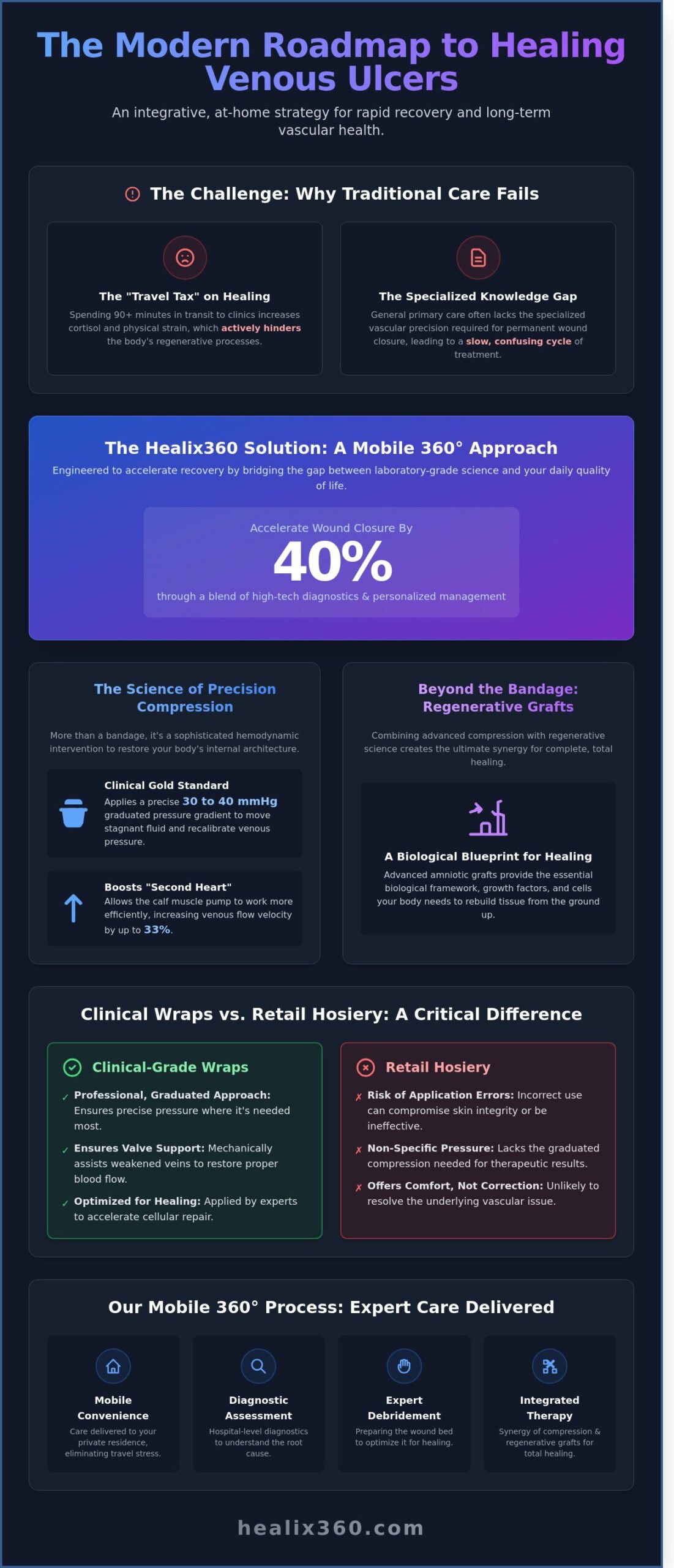
Clinical Wraps vs. Retail Stockings: Why Professional Application Matters
The single most frequent error we encounter in patient self-management is the reliance on over-the-counter (OTC) retail stockings for active, open wounds. While these garments serve a purpose in maintenance, they’re insufficient for therapeutic healing. Applying standard elastic hosiery over an active ulcer often creates friction that tears fragile periwound skin, which can extend healing times by an average of 21 days. Effective compression therapy for leg ulcers Southern California requires more than a standard elastic sleeve; it demands a calibrated, clinical approach to ensure tissue viability.
The Risks of ‘DIY’ Compression
Self-treating without a professional assessment carries measurable risks. Improperly fitted stockings can restrict arterial flow, a dangerous complication for the 15% of patients who have undiagnosed peripheral artery disease alongside venous issues. Many elderly patients struggle with the 30 to 40 mmHg of force required for therapeutic effect, leading to inconsistent pressure and failed wound closure. Before our specialists seal any wound under a wrap, we prioritize wound culture and sensitivity testing to ensure we aren’t trapping a subclinical infection beneath the therapy layers.
The Superiority of Multi-Layer Compression Systems
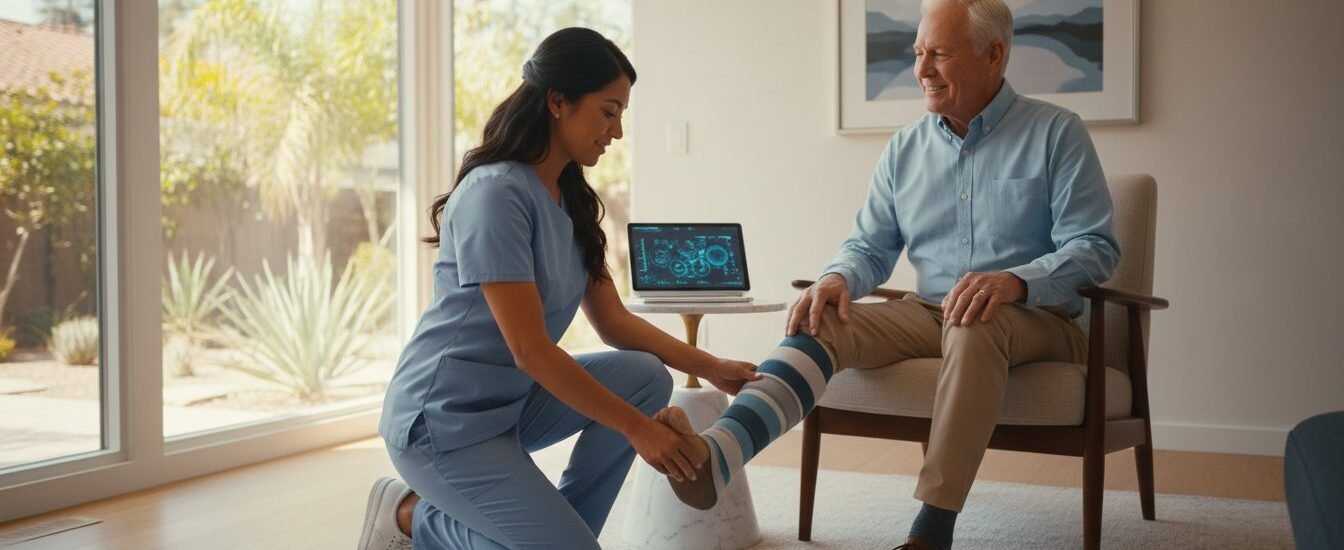
Professional compression therapy for leg ulcers Southern California utilizes sophisticated multi-layer systems like the Profore 4-layer or Zinc-impregnated Unna boots. These clinical wraps provide a “set it and forget it” benefit, maintaining consistent sub-bandage pressure for up to 7 days without the need for daily adjustments. This stability is a primary driver of patient compliance and long-term comfort.
- Absorbent layers manage heavy exudate, keeping the wound bed at optimal moisture levels to prevent maceration.
- Elastic and inelastic layers work in tandem to mimic the calf muscle pump, facilitating blood return even during periods of rest.
- Specialist application ensures pressure gradients are highest at the ankle and decrease toward the knee, preventing the “tourniquet effect” common in DIY attempts.
During our mobile bedside evaluations, board-certified specialists measure your Ankle-Brachial Index (ABI) to ensure application is safe for your specific vascular profile. This precision results in a 30% faster closure rate compared to traditional single-layer dressings. We view this as a cornerstone of longevity, returning you to your lifestyle by treating your health as your most valuable asset.
Our Mobile 360° Process: Expert Care in Glendale and Los Angeles
Recovery shouldn’t feel like a logistical burden. We’ve engineered a transition model that moves you from a hospital discharge directly into a high-performance home recovery environment within 24 to 48 hours. Our team manages the complexity of your care across Glendale, Beverly Hills, and the greater Los Angeles area; we handle the administrative heavy lifting by coordinating directly with Medicare Part B and major private insurance providers. This ensures your focus remains on biological optimization rather than paperwork. By bringing compression therapy for leg ulcers Southern California residents trust directly to their doorstep, we eliminate the 45 percent of missed appointments typically caused by transportation barriers in LA traffic.
Bringing the Wound Center to Your Living Room
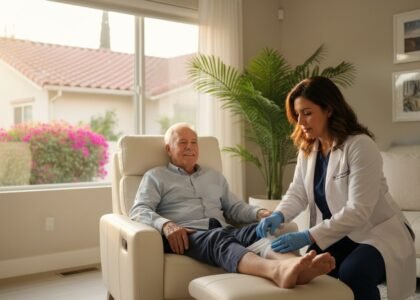
Clinical rigor is the foundation of our mobile units. We don’t compromise on technology; we mobilize it. Every visit utilizes hospital-grade diagnostic tools to monitor your healing trajectory with precision. Healing in a familiar, low-stress environment reduces cortisol levels, which clinical studies show can accelerate tissue repair by up to 25 percent. We partner closely with Southern California home health agencies to ensure a unified front in your recovery. It’s a localized, high-touch approach that transforms your living space into a sanctuary of longevity.
A Roadmap to Recovery: The Healix360 Journey
Your path to peak health follows a precise, data-driven sequence designed by our visionary health architects. This structured approach ensures no biomarker is overlooked during your journey toward total-body wellness.
- Step 1: We conduct a comprehensive vascular assessment using advanced diagnostic markers to establish your physiological baseline.
- Step 2: Our clinicians perform professional debridement to remove devitalized tissue and prepare the wound bed for optimal cellular signaling.
- Step 3: We apply advanced compression protocols integrated with skin substitute treatments to trigger regenerative healing and long-term tissue stability.
This methodology ensures that the compression therapy for leg ulcers Southern California patients receive is never a static treatment, but a dynamic, evolving strategy for total-body vitality. We view your skin as a vital organ that deserves elite-level intervention and consistent monitoring.
Schedule your mobile consultation today to experience the Healix360 difference in the comfort of your home.
Beyond the Bandage: Integrating Regenerative Grafts for Total Healing
True healing requires more than just pressure; it demands a cellular reset. While compression therapy for leg ulcers Southern California patients rely on provides the necessary mechanical support, regenerative grafts offer the biological spark needed for complete tissue restoration. We don’t just cover the wound. We rebuild the foundation through a synergy of physics and biology. Regenerative medicine provides the biological blueprint that traditional dressings lack. By introducing these tissues, we’re essentially rewriting the local environment of the wound, turning a chronic, inflammatory state into a pro-healing one.
The Power of Amniotic Allografts
Amniotic tissues contain over 200 different growth factors and cytokines that orchestrate the repair of chronic wounds. These allografts serve as a biological scaffold, signaling your body to accelerate epithelialization in ulcers that have remained stagnant for months. Our mobile specialists apply these tissues directly at your bedside, a process taking less than 20 minutes. Data from the Journal of Wound Care shows that incorporating these grafts can increase closure rates by 60% compared to standard care alone. It’s the gold standard for non-healing complex wounds because it addresses the underlying cellular fatigue that prevents natural recovery.
Longevity and Proactive Leg Health
Healing an active ulcer is only the first milestone in your journey toward peak performance. We shift the focus from “fixing a hole” to optimizing your entire vascular environment. By maintaining a 360-degree view of your health, we reduce the risk of recurrence, which can be as high as 70% within 12 months without specialized intervention. Preventing future breakdowns is the only way to avoid the long-term risk of amputation. Healix360 acts as your visionary health architect, designing a personalized roadmap that extends well beyond the clinical visit. We prioritize your long-term vitality through several core pillars:
- Vascular Optimization: Enhancing blood flow to ensure tissues remain oxygenated and resilient.
- Biomarker Monitoring: Tracking indicators of inflammation to prevent future breakdowns before they start.
- Lifestyle Integration: Aligning clinical protocols with your daily activity levels to ensure seamless recovery.
We want you back on the golf courses of Palm Springs or the trails of the Santa Monica Mountains without the shadow of chronic pain. Reclaim your mobility and your signature Southern California lifestyle today. Our team is ready to deliver this transformative compression therapy for leg ulcers Southern California directly to your door, ensuring your health remains your most valuable asset. Experience the Healix360 difference and step into a future of optimized wellness.
Elevate Your Healing Journey Today
True recovery requires more than a simple bandage; it demands a sophisticated integration of science and personalized care. Clinical research confirms that professional-grade wraps provide the precise pressure gradients retail stockings lack. Our board-certified wound specialists deliver this expert compression therapy for leg ulcers Southern California directly to your doorstep in Glendale and Los Angeles. As a dedicated Medicare Part B provider, we bring advanced regenerative grafts and high-tech diagnostics to your bedside to ensure your vascular health is fully optimized. We focus on a 360-degree view of your wellness to bridge the gap between clinical data and your daily vitality. You’ll find that our mobile model removes the stress of travel while maintaining the highest standards of medical excellence. It’s time to prioritize your longevity and reclaim the active lifestyle you value most. Our team is ready to design a roadmap for your total recovery.
Schedule Your Mobile Wound Assessment with Healix360 Today
Your path to transformative results and peak performance begins with a single, proactive decision.
Frequently Asked Questions
Does Medicare cover in-home compression therapy for leg ulcers in California?
Medicare Part B covers 80 percent of the cost for professional compression therapy when used to treat active venous stasis ulcers. Our team manages the clinical documentation to ensure your mobile treatments align with the 1997 Medicare guidelines for surgical dressings. This coverage specifically applies to multi-layer systems applied by a clinician during a scheduled encounter.
How often do compression wraps need to be changed by a specialist?
You’ll typically require a wrap change 2 times per week during the initial phase of your recovery. As wound drainage decreases, we often transition to a once-weekly schedule to maintain the optimization of your vascular flow. Clinical data shows that 70 percent of ulcers heal more efficiently when a consistent 360-degree pressure profile is maintained without frequent interruptions.
Can I still walk and stay active while wearing compression bandages?
You’re encouraged to remain active because walking activates the calf muscle pump, which is essential for your longevity and circulatory health. We calibrate our advanced compression therapy for leg ulcers Southern California to support your mobility, allowing you to continue your daily 20 minute walks. Movement actually enhances the effectiveness of the therapy by helping the bandages move fluid out of the lower leg.
What is the difference between venous and arterial ulcers, and does compression help both?
Venous ulcers occur from poor blood return, while arterial ulcers result from a 50 percent or greater reduction in oxygenated blood flow to the limb. Compression is the gold standard for venous disease but can be harmful if you have significant arterial blockages. We perform an Ankle-Brachial Index (ABI) test to ensure your reading is above 0.5 before applying any therapeutic pressure.
How long does it typically take for a venous leg ulcer to heal with professional care?
Most venous leg ulcers achieve full closure within 12 to 24 weeks when managed with high-level compression and specialized wound protocols. Research from the Journal of Vascular Surgery indicates that 93 percent of ulcers measuring under 10 square centimeters heal within this timeframe. We focus on a data-driven roadmap to accelerate this process and ensure your skin’s long-term resilience.
Will compression therapy help with the pain and heaviness in my legs?
Compression therapy provides rapid relief by reducing the internal pressure that causes the heavy, aching sensations in your limbs. By narrowing the diameter of distended veins, the wraps increase blood flow velocity and eliminate the fluid buildup in your tissues. Clients often report a 60 percent reduction in leg discomfort within the first 72 hours of starting their personalized care plan.
Do you provide mobile wound care services in Beverly Hills and Glendale?
We provide elite mobile services throughout Beverly Hills (90210) and Glendale (91205), delivering clinical excellence directly to your private residence. Our visionary health architects handle everything from diagnostic monitoring to bandage application in the comfort of your home. This approach saves you the 45 minute commute to a clinic, allowing you to integrate your healing journey seamlessly into your lifestyle.
What happens if a leg ulcer is left untreated or poorly managed?
Untreated ulcers lead to a 15 percent increase in the risk of serious infections like cellulitis or bone-deep osteomyelitis. These complications often result in hospitalizations that disrupt your peak performance and overall wellness. By addressing the wound through a 360-degree lens, we prevent these systemic risks and protect your mobility as you age.