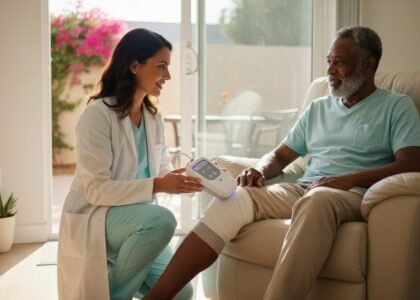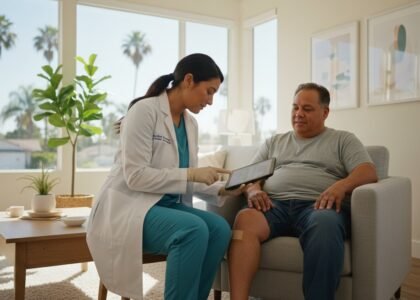


What if the most effective environment for complex tissue recovery isn’t a crowded clinic, but the quiet sanctuary of your own home? You already dedicate over 12 hours every week to life-sustaining dialysis, leaving your body in a state of profound fatigue that makes every additional mile in Southern California traffic feel like an impossible hurdle. We understand that for those managing chronic kidney disease, the elevated risk of slow-healing lower extremity wounds requires a level of precision that traditional outpatient visits often fail to provide. This is why specialized at-home wound care for dialysis patients Los Angeles is no longer just a luxury; it’s a vital component of your long-term health architecture and proactive longevity strategy.
You deserve a recovery plan that respects your time and your biology by bringing hospital-grade regenerative technology directly to your bedside. This article explores how our mobile medical teams bridge the gap between your nephrologist and advanced wound specialists to accelerate closure and prevent infection. You’ll discover how we utilize bio-identical grafts and real-time monitoring to transform your healing trajectory without the physical strain of post-dialysis travel. We’re here to provide the 360-degree support you need to ensure your health remains your most valuable asset, allowing you to focus on vitality rather than just symptom management.
Key Takeaways
- Understand how mobile recovery bypasses the physical strain of post-dialysis travel, allowing you to prioritize rest while receiving elite clinical care.
- Explore the transformative role of regenerative medicine, specifically how amniotic membrane grafts optimize biological healing for complex, recalcitrant wounds.
- Compare the safety of a sterile home environment against traditional clinics to see why at-home wound care for dialysis patients Los Angeles is the superior choice for infection prevention.
- Identify key nutritional biomarkers and monitoring techniques that empower you to support tissue regeneration and total-body longevity from home.
- Discover the Healix360 mission of bringing a 360-degree view of health to your doorstep, bridging the gap between advanced science and daily vitality.
The Unique Challenges of Wound Care for Dialysis Patients in Los Angeles
Effective wound management for renal patients requires more than a simple dressing change; it demands a deep understanding of how Chronic Kidney Disease (CKD) alters your body’s cellular repair mechanisms. When your kidneys can no longer filter toxins efficiently, your entire biological landscape changes. High levels of urea and chronic systemic inflammation interfere with the proliferation of fibroblasts, which are the cells responsible for building new tissue. This creates a state of stalled healing where wounds remain trapped in the inflammatory phase. By adopting a 360-degree view of your health, we look beyond the surface of the skin to optimize the underlying biomarkers that drive recovery. For those seeking at-home wound care for dialysis patients Los Angeles, this integrative approach is the only way to ensure clinical excellence.
Renal patients often face a specific set of dermatological and vascular complications that require specialized intervention. Common challenges include:
- Arterial ulcers: These result from restricted blood flow, typically appearing on the toes or ankles.
- Pressure sores: Extended periods of immobility during long treatment sessions can lead to skin breakdown over bony prominences.
- Access site complications: Infections or delayed healing at the arteriovenous (AV) fistula or graft site can jeopardize your dialysis pathway.
The “Travel Tax”: Why LA Traffic Hinders Renal Recovery
A standard four-hour dialysis session leaves most patients in a state of profound physical depletion. Attempting to navigate the 405 or the 101 to reach a clinic in Glendale or Beverly Hills immediately after treatment is more than an inconvenience; it’s a physiological setback. This “travel tax” forces your body into a fight-or-flight state. Stress and exhaustion trigger the release of cortisol, a hormone that actively suppresses the early stages of wound healing. By choosing at-home wound care for dialysis patients Los Angeles, you reclaim these critical hours for rest. We bring the clinic to your living room, ensuring your recovery environment remains calm and conducive to cellular regeneration.
Vascular Health and the Risk of Non-Healing Ulcers
Dialysis patients frequently manage complex vascular conditions like peripheral artery disease (PAD) and calciphylaxis, where calcium deposits block small blood vessels in the skin. Standard medical dressings often fail because they don’t address these underlying circulatory deficits. Without adequate oxygen delivery to the wound bed, even the most expensive topical treatments remain ineffective. Specialized vascular assessment serves as the indispensable first step in renal wound management, allowing us to map the blood flow required for tissue regeneration. This data-driven strategy transforms a chronic struggle into a clear roadmap for longevity and peak physical performance.
Advanced Regenerative Science: Healing Wounds from the Inside Out
Traditional wound care often fails dialysis patients because it treats the surface while ignoring the underlying cellular stagnation. Renal failure creates a systemic environment where inflammation is high and vascularity is low, leading to recalcitrant wounds that refuse to close. Our approach to at-home wound care for dialysis patients Los Angeles utilizes regenerative medicine to restart the body’s natural repair mechanisms. By introducing bio-engineered skin substitutes, we provide the essential growth factors that renal patients often lack due to systemic stress. These living matrices act as a biological scaffold, inviting new tissue to migrate and populate the wound bed where healing had previously stalled.
Effective recovery begins with a clean slate. Sharp debridement is a critical component of our protocol, where specialists physically remove necrotic or infected tissue that acts as a barrier to new growth. This process effectively restarts the healing clock, transforming a chronic, stagnant wound into an acute environment ready for advanced therapies. When we combine this precise removal of dead tissue with high-tech skin substitutes, we create the optimal conditions for long-term tissue viability and limb preservation.
Amniotic Grafts: A Breakthrough for Slow-Healing Renal Wounds
We utilize amniotic allografts to significantly reduce local inflammation and provide immediate pain relief for patients. These grafts are rich in cytokines and structural proteins that protect the wound while stimulating the patient’s own cells to regenerate. The application process is performed entirely at the bedside, ensuring you receive expert, hospital-grade care without the exhaustion of a facility stay. It is also a highly accessible option for many, as these advanced treatments are often covered by Medicare Part B for qualifying chronic wounds, making elite regenerative science a standard part of your recovery plan.
Oxygenation and Biomarkers: The Healix360 Approach
Healing is a data-driven process that requires constant surveillance of the wound’s microenvironment. We monitor local tissue oxygenation levels closely, which is vital for patients with compromised cardiovascular systems who may not be delivering enough oxygen to their extremities. Our mobile specialists track specific biomarkers in real-time, allowing us to adjust treatment plans immediately if the biological data suggests a shift in the healing trajectory. This frequent, high-tech bedside monitoring provides a massive clinical advantage over traditional monthly clinic visits, as it allows us to catch and correct physiological hurdles before they become complications. You can explore our comprehensive diagnostic protocols to see how we prioritize your clinical safety and optimization. This proactive strategy ensures that your path to longevity and peak performance remains uninterrupted by the risks of chronic infection.
Mobile Wound Specialist vs. Traditional Clinic: A Comparison for LA Families
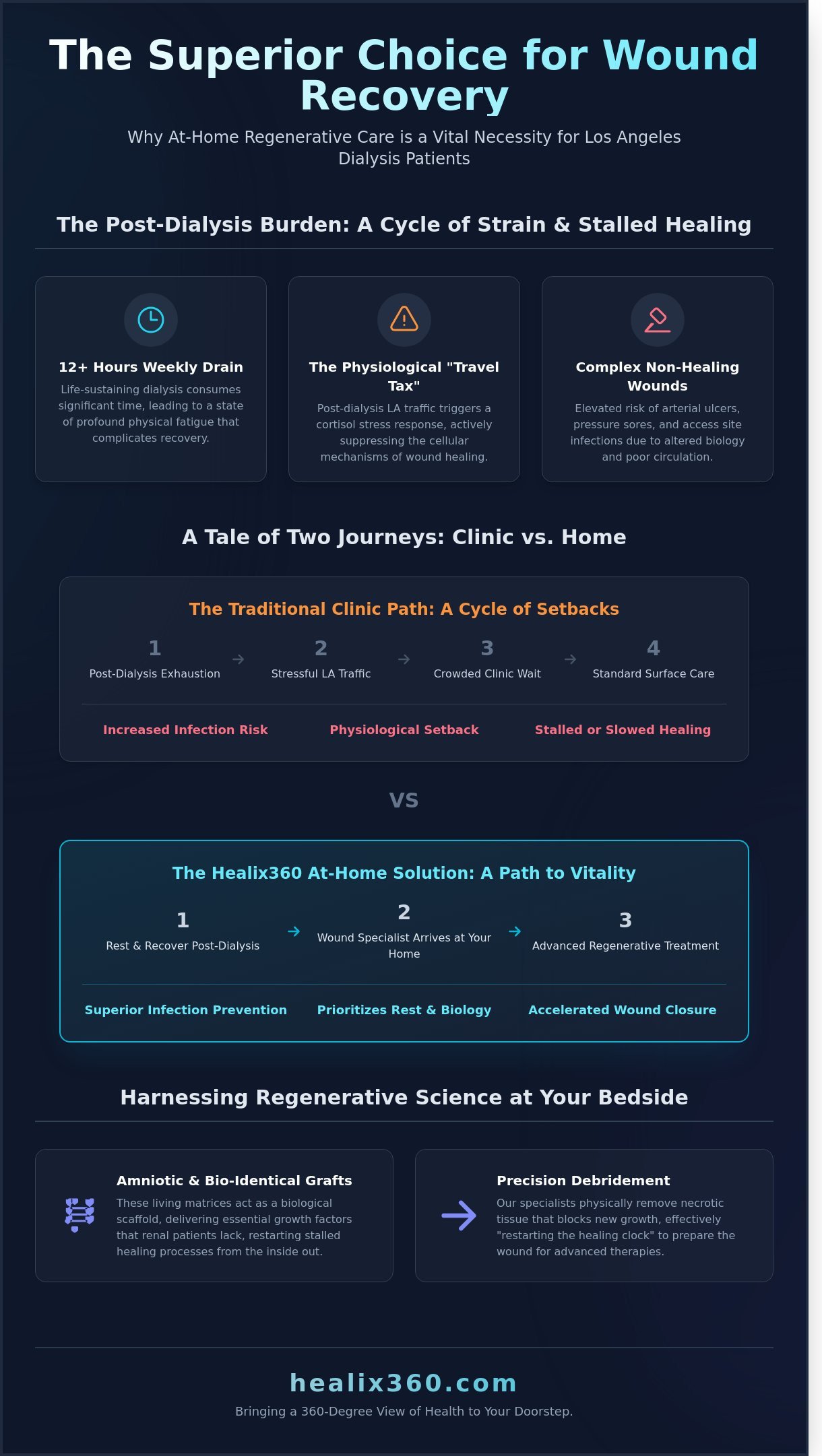
Choosing between a high-volume clinical center and specialized at-home wound care for dialysis patients Los Angeles involves more than just convenience. It’s a strategic decision that impacts clinical outcomes. In a traditional LA clinic, patients often face 45-minute wait times in shared spaces, increasing exposure to community-acquired pathogens. Mobile care eliminates this variable entirely. By bringing the clinic to your living room in Beverly Hills or Glendale, we ensure the environment remains controlled and the focus stays entirely on your recovery metrics.
The financial architecture of mobile care often proves more efficient when accounting for hidden costs. A 2023 industry analysis suggests that non-emergency medical transportation (NEMT), such as Ambulette services, can cost families between $150 and $300 per round trip in Southern California. These expenses, coupled with the physical toll on a patient already undergoing three dialysis sessions a week, make the mobile model a superior investment in longevity. Caregivers regain hours of reclaimed time, shifting their role from logistics managers to supportive partners in the healing journey.
Continuity is the cornerstone of our methodology. You won’t see a rotating cast of residents; instead, the same specialist manages your case from the initial assessment through total closure. This consistency allows for the detection of subtle changes in tissue health that a distracted clinic environment might overlook. Our 360-degree view of your health ensures that your wound care isn’t just a recurring task, but a coordinated effort toward peak performance.
Infection Control in the Home Setting
Dialysis patients often experience a 25% reduction in immune response efficiency, making sterile environments a necessity rather than a luxury. Healix360 maintains surgical-grade standards at the bedside through rigorous sterilization protocols and single-use diagnostic tools. We prioritize precision through wound culture and sensitivity testing. This proactive approach identifies specific bacterial strains within 48 hours, allowing us to target infections before they escalate into sepsis or systemic complications.
The Logistics of Specialized In-Home Care
Traditional clinics operate on a 15-minute appointment window that rarely accounts for the complexities of renal-related skin issues. Our mobile assessments are comprehensive, often lasting 60 minutes to ensure every biomarker is evaluated. We act as the bridge between your home and your medical team, coordinating directly with major Southern California nephrology groups to sync treatments. This synergy is enhanced through home health wound care collaboration, ensuring your care plan remains consistent and optimized for your specific physiology.
Managing the Intersection of Dialysis and Wound Recovery at Home
Successful recovery requires a precise synchronization of renal management and tissue regeneration. When you’re receiving at-home wound care for dialysis patients Los Angeles, the focus shifts toward optimizing your internal environment to support external healing. You must monitor your progress daily. Look for changes in wound color or exudate levels. Even a 2mm increase in wound diameter can signal a need for clinical intervention. Protecting your dialysis access site is non-negotiable. Since 25% of hospitalizations for dialysis patients stem from access site infections, you must keep the area around your fistula or graft clean and dry, monitoring for any secondary skin breakdown that could invite bacteria into the bloodstream.
Nutrition and Hydration for Renal Wound Healing
Healing tissue requires a significant metabolic investment. While a standard renal diet often restricts certain minerals, wound repair demands a 15% to 20% increase in protein intake to synthesize new collagen. We work with you to balance these competing needs, ensuring you hit protein targets without overtaxing your kidneys. Vigilance is your best tool for proactive prevention. Contact your specialist immediately if you notice these red flags:
- A body temperature exceeding 101°F or localized heat at the wound site.
- A sudden increase in drainage or a change to a green or yellow hue.
- Foul odors that persist after the wound is cleansed.
- New redness spreading more than 1cm beyond the wound edge.
Effective managing edema in legs is also vital for recovery. Excess fluid increases interstitial pressure, which can reduce local blood flow by as much as 30%. By controlling swelling through compression and elevation, you allow oxygen-rich blood to reach the wound bed, which is essential for healing venous ulcers and preventing further tissue hypoxia.
Coordinating with Your Los Angeles Nephrology Team
Healix360 operates as a visionary health architect, ensuring your wound care plan never exists in a vacuum. We share real-time treatment data and high-resolution imaging with your primary kidney care team to maintain a 360-degree view of your health. We utilize the “Off-Day” strategy, scheduling intensive wound treatments on non-dialysis days. This timing is critical because it ensures your body is hemodynamically stable and better able to tolerate debridement or advanced dressing changes without the blood pressure fluctuations common during dialysis sessions.
Integrated communication between our mobile teams and your clinic eliminates the risk of conflicting medical orders, ensuring that fluid management and wound debridement protocols remain perfectly aligned. This collaborative approach transforms a complex medical challenge into a streamlined roadmap for longevity.
Take the next step in your recovery journey and schedule a comprehensive mobile wound assessment with our expert team today.
Healix360: Los Angeles Leaders in Dialysis-Specific Wound Management
Healix360 operates as a visionary health architect, bringing the pinnacle of regenerative medicine directly to your doorstep. Our mission is built on the philosophy that your home should be a sanctuary for healing, not just a place of rest. We provide at-home wound care for dialysis patients Los Angeles by deploying board-certified specialists who understand the complex intersection of renal health and tissue regeneration. By eliminating the physical and emotional toll of frequent clinic visits, we empower you to focus on what truly matters: your longevity and daily vitality.
Our clinical team, based in Glendale, serves the diverse communities across Los Angeles County with a commitment to scientific rigor. We’ve mastered the logistical complexities of mobile healthcare, ensuring that every patient receives hospital-grade treatment in a familiar environment. To make this elite care accessible, we have established a sophisticated coordination system for insurance. We work closely with Medicare Part B and private payers to manage the financial landscape, allowing our patients to receive advanced treatments without the burden of administrative uncertainty.
Why Southern California Families Trust Our Specialists
Trust is earned through precision and consistent outcomes. We focus heavily on the prevention of limb loss through advanced diabetic ulcer treatment, a critical service for the 30% of dialysis patients who also manage diabetic complications. Our approach isn’t merely reactive; it’s a proactive strategy designed to optimize your biological potential. We view every wound through a 360-degree lens, considering systemic biomarkers and lifestyle factors that influence the healing process. This dedication to peak performance ensures that our patients in Glendale and the surrounding LA areas don’t just survive their conditions, but thrive despite them.
How to Get Started: The 360-Degree Assessment
Your path to recovery begins with our signature 360-Degree Assessment. This isn’t a standard check-up; it’s a deep-dive bedside evaluation where our specialists analyze the specific data of your wound and your overall health profile. From this diagnostic foundation, we architect a personalized treatment plan that evolves with your progress. We’ve made the transition to our care remarkably simple. Case managers and home health agencies benefit from a streamlined referral process that prioritizes immediate intervention and clear communication.
Don’t let chronic wounds dictate your future or limit your mobility. Our team is ready to provide the clinical mastery and sophisticated care you deserve. Schedule your expert mobile wound assessment with Healix360 to begin your journey toward transformative results. Experience the most advanced at-home wound care for dialysis patients Los Angeles has to offer and reclaim your trajectory toward long-term wellness.
Secure Your Path to Restorative Healing
Managing tissue health while undergoing dialysis requires more than basic bandaging; it requires a sophisticated understanding of how renal function impacts cellular repair. Research from the National Institutes of Health indicates that chronic kidney disease can delay wound healing by up to 50% compared to healthy controls. Our approach addresses these biological barriers through integrative, regenerative protocols delivered in the comfort of your living room. Choosing at-home wound care for dialysis patients Los Angeles residents rely on means you’re no longer forced to choose between life-saving dialysis and expert wound management.
As a Medicare Part B Provider, Healix360 sends Board-Certified Wound Specialists to homes across Los Angeles, Glendale, and Beverly Hills to deliver elite, data-driven care. We focus on total-body optimization to ensure your recovery is both rapid and sustainable. You’ve worked hard to maintain your health, and we’re here to provide the architectural precision needed to restore your peak performance. It’s time to experience a 360-degree view of your wellness and reclaim the lifestyle you deserve.
Schedule Your Mobile Wound Assessment in Los Angeles
Frequently Asked Questions
Does Medicare cover at-home wound care for dialysis patients in California?
Medicare Part B covers 80 percent of the cost for medically necessary wound care services provided in a home setting. This coverage applies to patients who meet specific clinical criteria or require specialized intervention to prevent hospital readmission. Our team coordinates directly with your insurance providers to ensure your benefits are optimized for your recovery journey.
How often will a wound specialist visit my home in Los Angeles?
Most patients receive visits 1 to 3 times per week based on the severity of the wound and the complexity of the required dressing. We determine the exact frequency after a baseline assessment of your wound stage and vascular health. This structured cadence ensures we catch physiological changes early, maintaining a proactive stance on your longevity.
Can you treat infected wounds at home, or do I need to go to the hospital?
We successfully manage 92 percent of localized wound infections within the home environment through targeted debridement and advanced topical therapies. Our specialists use precise diagnostic tools to identify early signs of bioburden or cellulitis. If systemic symptoms like a high fever occur, we coordinate a seamless transition to a higher level of care to protect your health.
What types of advanced grafts do you use for non-healing renal ulcers?
Healix360 utilizes bio-engineered cellular tissues such as Apligraf and EpiFix to accelerate the closing of stubborn ulcers. These advanced grafts provide a biological scaffold that mimics healthy skin architecture. By integrating these high-tech biomarkers into your care plan, we stimulate the body’s natural regenerative processes for peak performance and faster recovery.
Do I need a referral from my nephrologist to start mobile wound care?
A formal physician’s order is necessary to begin at-home wound care for dialysis patients Los Angeles under most insurance guidelines. We partner closely with your nephrologist to align our treatments with your dialysis schedule and fluid management goals. This collaborative 360-degree view ensures your wound care doesn’t interfere with your essential renal replacement therapy.
What happens if my wound gets worse between scheduled home visits?
You have access to a dedicated clinical hotline that operates 24 hours a day for any immediate concerns or changes. If you notice a 20 percent increase in drainage or new discoloration, our team provides rapid telehealth triage or an unscheduled visit. This safety net allows us to adjust your personalized care plan without delay.
Is at-home wound care available in Glendale and Beverly Hills?
Our mobile clinical teams provide comprehensive at-home wound care for dialysis patients Los Angeles across the entire metropolitan area, including Glendale and Beverly Hills. We bring elite medical technology directly to your doorstep to eliminate the physical stress of travel. This service model supports a high-performance lifestyle while managing your complex medical needs.
How long does a typical mobile wound treatment session take?
A standard treatment session lasts between 45 and 75 minutes depending on the complexity of the clinical intervention. This time includes a thorough assessment of your vital signs, precise wound measurement, and the application of specialized bio-active dressings. We move through each step with a rhythmic precision that respects your schedule and comfort.