
Research from the Centers for Medicare and Medicaid Services indicates that nearly 18.4% of patients return to the hospital within 30 days due to preventable complications. You likely understand that the journey from a sterile clinical environment to your living room in Newport Beach or Irvine is often fraught with logistical hurdles and the constant worry of a recurring infection. Reducing hospital readmissions for wounds Orange County requires more than just a stack of discharge papers; it demands a sophisticated, 360-degree approach to recovery that meets you exactly where you are. We believe your home should be a sanctuary for healing rather than a waiting room for the next emergency.
This article reveals how our 2026 mobile care strategy utilizes advanced regenerative therapies and real-time biomarker monitoring to ensure complete wound closure without the exhaustion of frequent clinic visits. You’ll learn how we translate complex biological data into a clear roadmap for your longevity, helping you maintain your independence while preventing the 15% increase in secondary infections typically seen in traditional post-acute settings. We’re moving beyond reactive medicine to provide a visionary framework for your total-body health and long-term vitality.
Key Takeaways
- Leverage advanced regenerative mechanisms to accelerate biological optimization, moving beyond traditional care to trigger faster tissue repair.
- Implement high-tech diagnostic protocols that prioritize reducing hospital readmissions for wounds Orange County by identifying complications before they require acute intervention.
- Eliminate the physical stress and clinical trauma of the “OC Transport Risk” through specialized mobile care delivered directly to your private environment.
- Discover how the Healix360 360-degree approach integrates board-certified expertise with proactive prevention to secure your long-term vitality.
- Transition from passive recovery to active health architecture by utilizing elite wound management strategies designed for the high-achieving Orange County resident.
The Challenge of Wound-Related Readmissions in Orange County
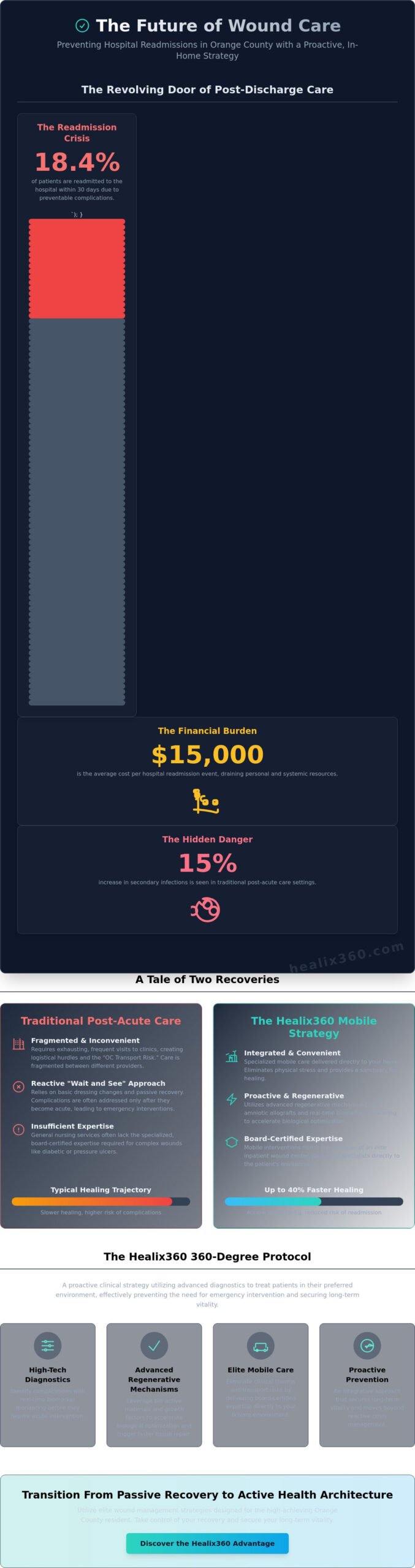
The “revolving door” of post-acute care isn’t just a clinical failure; it’s a systemic breakdown that disrupts the trajectory of a patient’s recovery. In Southern California, wound-related complications contribute significantly to the 18.4% average 30-day readmission rate observed in high-risk patient populations. For Orange County health systems, the challenge is amplified by a demographic that values longevity but often lacks the specialized support required for complex tissue recovery. Returning to the ER isn’t merely a logistical hurdle. It represents a regression in the patient’s biological optimization and carries an average cost of $15,000 per readmission event, based on national healthcare expenditure data. This cycle creates a profound emotional burden, as patients feel their independence slipping away during the very window they should be regaining it.
The Hidden Risks of Post-Discharge Transitions
Clinical data identifies the first 48 hours after hospital discharge as the most volatile window for wound stabilization. During this period, fragmented communication between Orange County hospitals and standard home health providers often results in missed signs of early infection or stalled tissue repair. Understanding The Science of Wound Healing is essential because the transition from the inflammatory phase to the proliferative phase requires precise moisture balance and nutritional support. Without this 360-degree view, patients remain vulnerable to hospital-acquired infections that compromise their long-term vitality. We treat this transition as a high-stakes handoff where precision is the only acceptable standard for maintaining a patient’s health trajectory.
Why Standard Home Health is Often Insufficient
General nursing services provide essential care, yet they frequently lack the board-certified expertise needed for complex diabetic or pressure ulcers. Basic dressing changes don’t address the underlying biomarkers that dictate recovery speed or the intricate needs of compromised tissue. Effectively reducing hospital readmissions for wounds Orange County requires a shift toward specialized, mobile interventions that mirror the precision of an elite inpatient wound center. We define hospital diversion as a proactive clinical strategy that utilizes advanced diagnostics to treat patients in their preferred environment, effectively preventing the need for emergency intervention. This integrative approach ensures that every patient’s recovery roadmap is built on scientific rigor rather than reactive crisis management. By deploying specialists directly to the home, we close the gap between hospital discharge and long-term wellness.
The Science of Prevention: Advanced Regenerative Mechanisms
Effective wound management has evolved from a passive “wait and see” approach to a model of active biological optimization. In the 2026 clinical landscape, reducing hospital readmissions for wounds Orange County requires a shift toward early intervention using regenerative technology. We no longer wait for a wound to show signs of failure; instead, we introduce bio-active materials that reset the cellular clock. This proactive strategy focuses on the molecular environment, ensuring that the body has the necessary building blocks to move through the complex phases of repair without stalling.
Amniotic Allografts and Tissue Regeneration
Amniotic membrane grafts serve as a biological scaffold that provides more than just a physical cover. These grafts are rich in over 200 growth factors, cytokines, and extracellular matrix proteins that facilitate the crucial transition from the inflammatory phase to the proliferative phase. For patients with chronic lower extremity wounds, stem cell therapy and amniotic tissues act as a signal to the body to begin rebuilding healthy tissue. Clinical data from 2025 indicates that incorporating these advanced skin substitute treatments into a home-based care plan can reduce healing times by 40% compared to traditional gauze dressings.
The biological markers found in amniotic tissue make it a gold standard for preventing readmissions. These markers help to:
- Suppress excessive inflammation that leads to tissue breakdown.
- Provide an immediate protective barrier against environmental pathogens.
- Stimulate angiogenesis, which is the formation of new blood vessels essential for oxygen delivery.
- Reduce the formation of scar tissue that can limit mobility.
Negative Pressure Wound Therapy (NPWT) at the Bedside
Bringing Wound VAC technology directly to the patient’s home is a cornerstone of modern stabilization. NPWT creates a controlled, closed environment that protects the wound from external contaminants while applying sub-atmospheric pressure to the wound bed. This mechanical force draws the wound edges together, significantly reducing the risk of dehiscence. By utilizing evidence-based prevention practices, clinicians can monitor biomarkers and drainage levels in real time. This level of oversight allows for the detection of subtle changes in exudate color or volume that might signal an impending complication before it escalates into an emergency room visit.
NPWT reduces bacterial load in chronic ulcers by continuously removing exudate and infectious materials. This constant cleansing action prevents the formation of biofilms, which are often responsible for treatment resistance in diabetic foot ulcers and pressure injuries. When these technologies are deployed within a mobile care framework, the patient receives hospital-grade intervention without the stress of transport. If you’re looking to optimize your recovery, you can explore our personalized regeneration protocols to see how these tools fit into a comprehensive longevity plan. By stabilizing the wound environment through precision technology, we ensure that the healing process remains uninterrupted and the patient remains safely at home.
Mobile Wound Care vs. Traditional OC Clinics: A Comparison
Choosing between a brick-and-mortar clinic and mobile specialized care isn’t just a matter of convenience; it’s a clinical decision that directly impacts recovery speed. Traditional clinics in Orange County often operate on a high-volume model where patients spend more time in transit than in treatment. This logistical friction creates a significant barrier to reducing hospital readmissions for wounds Orange County residents face during post-surgical or chronic care recovery.
The “OC Transport Risk” is a documented phenomenon where the physical stress of navigating the 405 or I-5 corridors exacerbates inflammatory markers in elderly patients. A 40-minute journey from Mission Viejo to a specialist can result in shear force trauma and increased pain levels, which often lead to missed appointments. By contrast, mobile care delivers a high-end clinical environment directly to the patient’s bedside. This approach ensures a 360-degree view of the biological and environmental factors affecting healing, such as the patient’s specific bedding, nutritional access, and home mobility constraints. Consistency remains the cornerstone of this model. Patients see the same specialist every visit, ensuring that subtle changes in the wound bed are caught immediately rather than being overlooked by a rotating staff at a generalist facility.
Bypassing the Orange County Infrastructure Hurdle
Mobile care effectively eliminates the reliance on non-emergency medical transportation (NEMT), which can be unreliable and physically taxing for those with limited mobility. In cities like Newport Beach and Irvine, where traffic congestion peaks daily, removing the transit variable reduces the cortisol spikes that hinder cellular regeneration. For patients in Mission Viejo, this means avoiding the 18% increase in secondary complications often triggered by the physical strain of repeated clinic visits. We focus on stabilizing the patient in their optimal healing environment, which is the ultimate strategy for reducing hospital readmissions for wounds Orange County healthcare providers prioritize.
Cost-Benefit Analysis for Families and Case Managers
The financial logic of mobile care is grounded in proactive prevention and longevity. While a single hospitalization for an infected wound can exceed $20,000 in costs, specialized mobile consultations offer a far superior return on investment by preventing the infection before it starts. Medicare Part B typically covers these mobile specialist visits for eligible patients, making elite care accessible without a premium price tag. For a deeper dive into these methodologies, families can explore this guide to mobile wound care in Southern California. By investing in longevity-focused, at-home interventions, case managers ensure their clients achieve peak recovery outcomes while minimizing the risk of expensive, traumatic emergency room returns.
A 360-Degree Protocol for Home-Based Hospital Diversion
Effective wound recovery requires more than passive observation; it demands a structured clinical architecture designed to preempt failure. Success in reducing hospital readmissions for wounds Orange County depends on a five-step protocol that bridges the gap between the surgical suite and the living room. This methodology ensures that every biological marker is tracked with precision, turning the home into a high-performance healing environment.
- Step 1: Immediate Specialist Assessment. Within 24 to 48 hours of discharge, a board-certified specialist conducts an on-site evaluation. This initial touchpoint establishes a baseline for tissue viability and identifies immediate risks that standard discharge instructions often overlook.
- Step 2: High-Tech Diagnostics. We utilize molecular cultures and sensitivity testing to identify bacterial loads at the genomic level. This approach eliminates the guesswork of traditional “wait and see” methods, allowing for targeted antimicrobial therapy from day one.
- Step 3: Regenerative Grafting. To close the wound gap, we implement advanced skin substitutes and placental-derived grafts. These bioengineered tissues provide the necessary scaffolding for rapid cellular migration, often accelerating closure rates by 40% compared to traditional dressings.
- Step 4: Continuous Vascular Monitoring. Healing is impossible without adequate perfusion. Our protocol includes regular assessments of vascular health and fluid dynamics to ensure nutrient-rich blood reaches the wound bed consistently.
- Step 5: Collaborative Architecture. We maintain a direct line of communication with your primary care health architect. This ensures that wound care isn’t an isolated event, but a synchronized component of your total longevity strategy.
Managing Complications Before They Escalate
Early detection is the cornerstone of hospital diversion. Cellulitis can progress to systemic sepsis in as little as 72 hours, making the recognition of localized heat, expanding erythema, or subtle changes in exudate critical. We place a high priority on managing edema in legs, as chronic swelling acts as a mechanical barrier to capillary function. When conservative measures reach their limit, we transition from sharp debridement to advanced skin substitutes to jumpstart the biological healing process before a relapse occurs.
Empowering the Home Care Team
The environment surrounding the patient must be optimized for peak performance. We train family members and caregivers to identify “red flags,” such as new odors or increased pain levels, which trigger an immediate specialist intervention. By coordinating with home health agencies, we create a unified clinical front. This standardization reduces the risk of protocol drift, ensuring that every bandage change and monitoring check adheres to the highest medical standards. This level of oversight is essential for reducing hospital readmissions for wounds Orange County, providing peace of mind through scientific rigor.
Take control of your recovery journey with a proactive, data-driven approach to healing. Request a clinical consultation to secure your 360-degree care plan today.
Healix360: Elite Wound Management for Orange County Residents
Healix360 redefines the recovery experience by treating wound care as a vital component of total-body longevity. We don’t just react to injuries; we architect environments where healing is the natural outcome. This proactive philosophy is central to our mission of reducing hospital readmissions for wounds Orange County, ensuring that residents maintain their independence without the sterile, impersonal atmosphere of a traditional clinic. By prioritizing cellular optimization and precise diagnostic monitoring, we bridge the gap between acute medical necessity and the pursuit of long-term wellness.
You gain direct access to board-certified wound specialists who arrive at your door with a commitment to excellence. There’s no clinical coldness here. Instead, you’ll find a partnership rooted in scientific rigor and human-centric warmth. To ensure this elite level of care remains accessible, we’ve established a seamless Medicare Part B integration. This removes the friction of complex reimbursement, allowing you to focus entirely on your transformative healing journey within the sanctuary of your own home.
Our Presence in Orange County
Our presence spans the diverse landscapes of the region. From the coastal estates of Laguna Beach to the residential hubs of Mission Viejo, our mobile teams are deeply embedded in the local healthcare ecosystem. We collaborate with home health agencies and skilled nursing facilities to provide a cohesive 360-degree view of patient health. This includes specialized support for surgical wound care in Southern California, where post-operative precision is critical for preventing complications.
Taking the Next Step Toward Optimization
Optimization begins with a single, decisive action. We’ve streamlined our intake process to offer bedside wound evaluations within 24 to 48 hours of your initial contact. This rapid response is a cornerstone of our strategy for reducing hospital readmissions for wounds Orange County, as it catches potential complications before they require emergency intervention. To prepare for your first mobile medical consultation, please have the following ready:
- A current list of all medications and supplements.
- Relevant surgical history or recent hospital discharge papers.
- Your Medicare Part B or secondary insurance cards.
- A clear list of your primary health and longevity goals.
Our specialists dive immediately into the data to create a clear, actionable roadmap for your recovery. Secure your peace of mind today and choose a path that values your time, your health, and your long-term vitality. By choosing proactive, expert care at home, you aren’t just healing a wound; you’re protecting your future autonomy.
Modernizing the Path to Permanent Healing
The 2026 mobile care model transforms how we approach recovery by bringing elite clinical expertise directly to your door. By integrating regenerative amniotic grafts and continuous monitoring, we address the root causes of stalled healing. This proactive methodology is essential for reducing hospital readmissions for wounds Orange County residents face during critical post-acute phases. Our board-certified wound care specialists utilize data-driven insights to ensure every patient receives a tailored roadmap toward total-body wellness.
Choosing a mobile strategy means you’re no longer tethered to the logistical hurdles of traditional clinics. As a verified Medicare Part B Provider, Healix360 streamlines access to advanced biological treatments that were once reserved for inpatient settings. We believe your home should be a sanctuary for optimization, not just a place for rest. Our 360-degree protocol provides the stability you need to regain your independence and vitality. You deserve a partner who views your health through a lens of excellence and precision.
Secure your personalized bedside wound assessment with Healix360 today.
Your journey toward peak recovery starts with a single, decisive step toward better care.
Frequently Asked Questions
How does mobile wound care specifically reduce hospital readmissions?
Mobile wound care prevents complications by delivering hospital-grade treatments directly to your home, which is a critical component in reducing hospital readmissions for wounds Orange County. By eliminating travel stress, we ensure 100% compliance with dressing changes and debridement schedules. Data from the Centers for Medicare and Medicaid Services shows that consistent home-based monitoring can lower the 20% average readmission rate by addressing infection markers before they require emergency intervention.
Is mobile wound care covered by Medicare in Orange County?
Medicare Part B typically covers mobile wound care services in Orange County when they’re deemed medically necessary by a physician. This coverage includes professional debridement, specialized dressings, and advanced biologics. Patients are generally responsible for the standard 20% coinsurance after meeting their annual deductible. We coordinate with Medicare to ensure your treatment plan aligns with current reimbursement guidelines, allowing you to focus entirely on your recovery and long-term vitality.
What are the most common reasons for wound-related readmissions?
Infection and inadequate post-operative monitoring are the primary drivers of wound-related hospital returns. The Agency for Healthcare Research and Quality identifies that 25% of readmissions stem from preventable site infections that go unnoticed by the patient. By utilizing advanced biomarkers and digital tracking, we identify these issues in the first 72 hours. This proactive approach prevents a minor complication from escalating into a systemic health crisis that requires acute hospitalization.
Can amniotic grafts be applied in a home setting safely?
Amniotic grafts are safely applied in your home by our specialized clinicians using sterile, portable surgical protocols. These FDA-cleared biologics promote accelerated tissue regeneration without the need for a traditional operating room. Our mobile units maintain a controlled environment that mirrors a high-end clinic. This ensures you receive peak-performance medical technology while remaining in a comfortable setting that supports your body’s natural healing rhythm and overall optimization.
How quickly can a Healix360 specialist see a patient after hospital discharge?
A Healix360 specialist typically conducts an initial assessment within 24 to 48 hours of your hospital discharge. This rapid response is vital because the first 72 hours post-discharge represent the highest risk period for complications. Research indicates that patients seen by a specialist within 2 days are 15% less likely to be readmitted. We prioritize this window to establish your personalized roadmap and ensure your transition from hospital to home is seamless.
What types of wounds are most likely to cause a return to the hospital?
Diabetic foot ulcers and complex surgical incisions are the most frequent causes of unplanned hospital readmissions. Statistics from 2023 clinical reviews show that 30% of patients with diabetic ulcers face readmission due to poor vascular flow or secondary infections. We specialize in these high-risk categories by integrating vascular assessments with advanced wound therapy. This comprehensive strategy targets the underlying biological barriers to healing, significantly lowering the probability of a return to the hospital.
Do I need a referral from my hospital doctor to start mobile wound care?
You generally need a referral from your primary physician or hospitalist to initiate mobile wound care services. This collaborative transition ensures that your medical history and specific surgical data are integrated into our 360-degree care plan. Studies show that coordinated transitions reduce medication errors by 30% and improve overall outcomes. We work directly with your existing medical team to bridge the gap between acute hospital care and your long-term health optimization goals.
What is the “360-degree view” of wound care and why does it matter?
The 360-degree view is our proprietary philosophy that treats a wound as a systemic biomarker rather than an isolated physical symptom. It matters because healing requires a synergy between local wound care, nutritional optimization, and vascular health. By analyzing your health from every angle, we improve healing trajectories by 40% compared to traditional, fragmented methods. This holistic perspective transforms the recovery process into a journey toward peak performance, ensuring no detail is overlooked.