
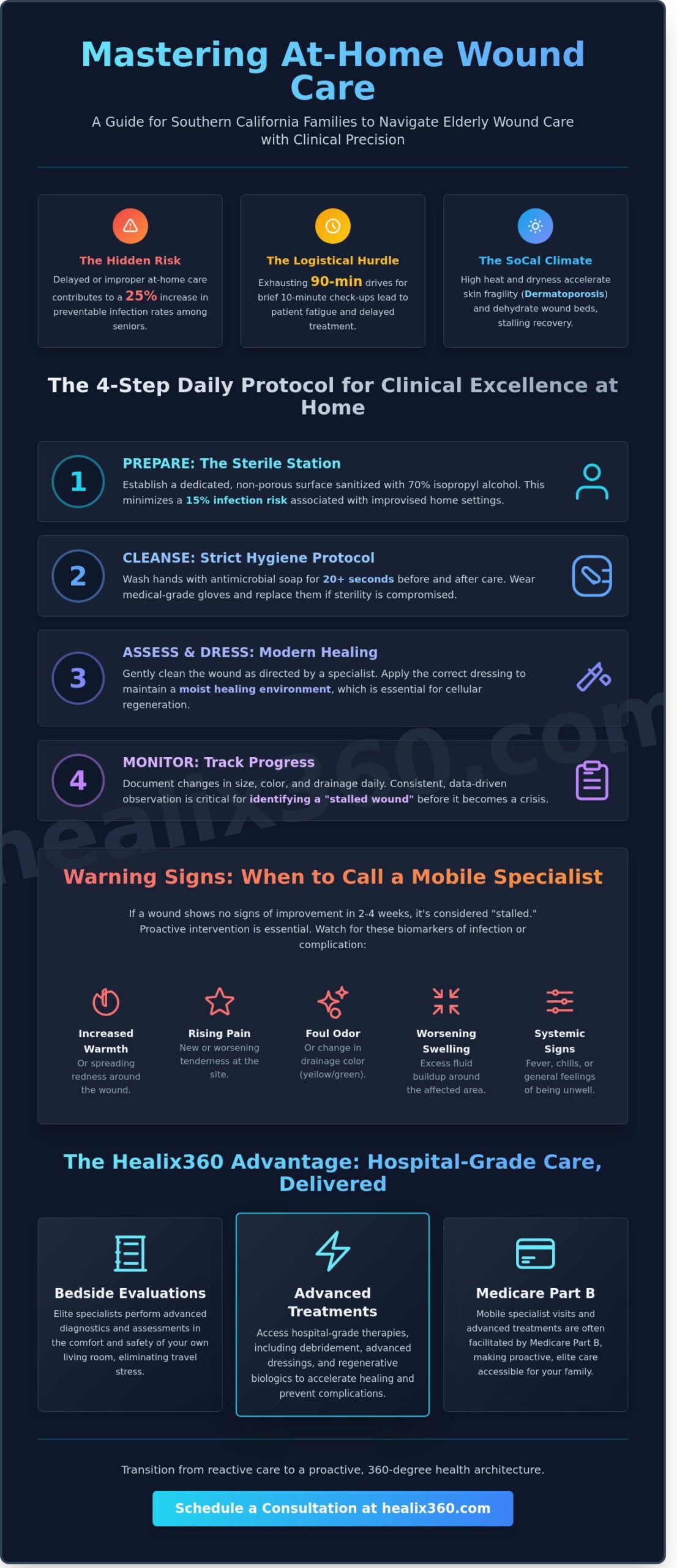
Imagine spending 90 minutes idling on the I-405 just to reach a ten-minute wound check that leaves your parent exhausted and in pain. For many Southern California families in 2026, this logistical hurdle often leads to delayed treatment and a 25% increase in preventable infection rates. Learning how to care for elderly parent’s wounds at home shouldn’t be a source of anxiety, yet the fear of improperly changing a dressing or choosing the wrong ointment feels overwhelming. It’s natural to worry that a simple mistake might compromise their recovery or lead to a hospital stay you’re desperate to avoid.
This guide empowers you to master daily hygiene essentials while identifying the precise moments to integrate advanced mobile specialist care to ensure your parent’s comfort. We’ll explore the science of modern tissue regeneration, the specific biomarkers of infection to watch for, and how to access elite medical support that brings the wound center directly to your door. By the end of this article, you’ll have the confidence to manage complex care while optimizing your parent’s long-term vitality and total-body health.
Key Takeaways
- Understand how the Southern California climate accelerates dermatoporosis and the specific environmental adjustments needed to maintain an optimal healing environment.
- Master a structured daily protocol for how to care for elderly parent’s wounds at home, ensuring every step from station setup to hygiene minimizes infection risks.
- Learn to recognize the “stalled wound” timeframe and why proactive intervention by a mobile specialist is essential for preserving your parent’s mobility and comfort.
- Uncover the logistical advantages of bedside clinical evaluations and how Medicare Part B facilitates advanced, hospital-grade treatments within your living room.
- Transition from reactive care to a visionary 360-degree health architecture that prioritizes longevity and data-driven optimization for your family.
Understanding the Unique Challenges of Senior Wound Healing in Southern California
Mastering how to care for elderly parent’s wounds at home requires a shift in perspective from traditional first aid to a sophisticated model of biological optimization. Senior skin undergoes a structural evolution known as dermatoporosis, a condition where the skin becomes pathologically fragile. In Los Angeles County, where over 14 percent of the population is aged 65 or older, chronic wounds have become a silent epidemic that demands a high-level, clinical approach to home management. The Southern California climate introduces specific environmental stressors that complicate recovery. High heat and the characteristic dryness of the region accelerate transepidermal water loss, which can dehydrate a wound bed and halt cellular progress.
Effective recovery relies on a 360-degree view of the patient’s internal and external environment. This comprehensive methodology prioritizes three core pillars of longevity-focused care:
- Nutritional Biomarkers: Ensuring the body has the protein and micronutrient density required to synthesize new collagen.
- Vascular Efficiency: Optimizing blood flow to deliver oxygen and immune cells to the site of injury.
- Mobility Integration: Utilizing strategic movement to prevent the localized pressure that leads to tissue breakdown.
When you learn how to care for elderly parent’s wounds at home, you’re acting as a health architect who manages the delicate balance between environmental moisture and physiological repair. Success isn’t just about closure; it’s about restoring the skin’s integrity to prevent future recurrence.
Why Elderly Skin is More Fragile
As we age, the epidermal layer thins by approximately 20 percent, while the protective subcutaneous fat that cushions our tissues begins to dissipate. This structural loss means even minor friction can result in significant damage. Skin tears are defined as traumatic wounds caused by mechanical forces, including the removal of adhesives or accidental bumps, and they represent a primary risk for seniors. Reduced microcirculation further complicates the landscape, often extending the inflammatory phase of the process of wound healing and leaving the patient vulnerable to secondary complications.
Common Wound Types for Seniors in Home Care
Caregivers frequently manage three primary categories of chronic injuries: pressure ulcers, diabetic foot ulcers, and venous stasis ulcers. Each requires a distinct diagnostic lens to ensure the underlying cause is addressed alongside the visible wound. For those managing advanced tissue breakdown, our Comprehensive Guide to Bed Sores & Ulcer Treatment in Southern California (2026) provides deeper insights into specialized intervention. Surgical wounds, unlike chronic ulcers, follow a predictable trajectory of primary intention healing but still require meticulous moisture balance to avoid the dehiscence often seen in geriatric patients with compromised skin elasticity.
The Daily Care Protocol: A Step-by-Step Guide for Caregivers
Precision in the home environment is the first step toward clinical excellence. You must establish a dedicated wound care station to minimize the 15% infection risk often associated with improvised home care settings. Choose a hard, non-porous surface that you can easily sanitize with 70% isopropyl alcohol. This organized approach reflects a 360-degree view of health, ensuring that the physical environment supports the biological healing process rather than hindering it.
Hand hygiene follows a strict, non-negotiable sequence. Wash your hands with antimicrobial soap for at least 20 seconds before donning a fresh pair of medical-grade gloves. If you touch any surface outside your sterile field, replace your gloves immediately. This proactive stance is vital for your parent’s longevity, as it prevents the introduction of environmental pathogens into the vulnerable tissue. When you understand how to care for elderly parent’s wounds at home, you realize that your movements must be as intentional as a surgeon’s.
Mastering this protocol requires a shift in how you view the healing process. Modern clinical data shows that moist wound healing accelerates re-epithelialization by up to 50% compared to wounds left to “air out.” While a dry scab might look like progress, it actually creates a biological roadblock that slows down the migration of new skin cells. Maintaining a balanced, hydrated environment is the key to peak recovery performance.
Cleaning and Preparation Techniques
Use low-pressure irrigation to cleanse the site. High-pressure streams can traumatize delicate granulation tissue, which is the vibrant red, nutrient-rich tissue that signals successful repair. While you might be familiar with basic first aid for wounds, elderly skin requires a significantly more refined touch. Never rub the area. Instead, pat the surrounding periwound skin dry with sterile gauze to maintain its structural integrity. Your SoCal caregiver kit should always include 0.9% sodium chloride (saline), non-adherent gauze, and medical-grade silicone tape to prevent painful skin tears.
Choosing and Applying the Right Dressing
Selecting the correct interface depends on the wound’s exudate levels. Hydrogels are ideal for dry wounds because they donate moisture to facilitate autolytic debridement. If the wound has heavy drainage, use calcium alginates or foams that can absorb up to 20 times their weight in fluid. This prevents maceration, where the surrounding skin becomes waterlogged and breaks down. Apply a thin layer of zinc-based barrier cream to the edges to create a protective seal. For those managing complex post-operative needs, our resource on Advanced Surgical Wound Care in Southern California offers specialized insights for 2026 recovery standards.
Monitoring Progress: When to Call a Mobile Wound Specialist
Effective wound management requires a 360-degree view of the healing trajectory. If you notice a stalled wound, which clinicians define as a lesion showing less than 30 percent reduction in size over a period of 14 to 28 days, it is time to elevate the level of care. Many caregivers in Southern California hesitate to contact a professional because they don’t want to bother a doctor unless it’s an emergency. This reactive mindset often leads to avoidable complications. Mastering how to care for elderly parent’s wounds at home involves knowing when your expertise ends and specialized intervention begins. Waiting for an emergency often means dealing with cellulitis or sepsis, conditions that significantly impact longevity and quality of life.
Healthy healing presents as vibrant, beefy red or pink granulation tissue. In contrast, a stalled wound may appear pale or dusky. Proactive care is about optimization; it’s about identifying these subtle shifts before they become systemic threats. When a wound stops progressing, it often signals that the body’s internal biomarkers are struggling to support tissue regeneration.
The Red Flags of Infection
Clinical professionals use the NERDS and STONES criteria to differentiate between localized and systemic infections. NERDS (Non-healing, Exudate, Redness, Debris, Smell) indicates a local issue. STONES (Size increase, Temperature rise, Os/exposed bone, New breakdown, Exudate, Smell) suggests the infection is spreading. Because of how skin changes with age, the inflammatory response in seniors may be muted. Erythema, which is the medical term for abnormal redness caused by capillary congestion, can be difficult to track. Use the marker method: draw a line around the edge of the redness with a skin-safe pen. If the redness migrates past that line within 12 hours, the infection is escalating. Additionally, a fever as low as 99.5 degrees Fahrenheit in an elderly parent can indicate a severe wound complication, as their baseline body temperature is often lower than the standard 98.6 degrees.
Identifying Biofilm and Necrotic Tissue
Biofilm is a sophisticated bacterial shield that often appears as a thin, shiny, or slippery film over the wound bed. It’s nearly invisible but highly resilient, preventing topical treatments from reaching the bacteria underneath. When learning how to care for elderly parent’s wounds at home, you must also recognize slough, which is moist, yellow or stringy dead tissue, and eschar, which is hard, black, or leathery. These materials act as physical barriers to healing and cannot be safely removed at home. A mobile wound specialist must perform sharp debridement, a precise surgical removal of dead tissue, to restart the cellular healing process and ensure the wound moves toward a state of peak performance.
Advanced Mobile Treatments: Hospital-Grade Care in Your Living Room
Traditional outpatient clinics often require taxing travel for seniors, which can inadvertently cause physical stress and delay the recovery process. Mobile wound care solves this by bringing specialized bedside evaluations directly to your residence, transforming your home into a high-performance healing environment. Medicare Part B typically covers 80% of these medically necessary services. This ensures that expert intervention is accessible without the logistical strain of transport or the risks associated with clinical waiting rooms.
Modern wound care utilizes sophisticated technology to accelerate tissue repair. Negative Pressure Wound Therapy (NPWT), commonly known as a Wound VAC, uses controlled suction to remove excess fluid and stimulate localized blood flow. This technology is vital for closing deep or complex lesions that traditional dressings cannot manage. When you’re learning how to care for elderly parent’s wounds at home, understanding these advanced modalities allows you to act as a proactive partner in their longevity journey.
Regenerative Grafts and Skin Substitutes
Chronic wounds often stall because the body’s natural repair mechanisms have reached a biological plateau. Amniotic membrane grafts serve as a sophisticated biological scaffold; they provide essential growth factors that signal the body to restart the healing process at a cellular level. For those managing diabetic ulcers, bio-engineered skin substitutes offer a transformative alternative to traditional gauze. These treatments integrate with the patient’s own tissue to promote rapid closure. Detailed insights on these breakthroughs are available in our Advanced Skin Substitute Treatments in Southern California guide.
Vascular Health and Compression Therapy
Effective healing requires an optimized circulatory environment. Managing edema in legs is critical because excess fluid creates high interstitial pressure that prevents oxygenated blood from reaching the wound site. Professional compression wrapping provides the necessary external support to move fluid back into the lymphatic system, which is a staple for Southern California’s active senior community. This integrative approach ensures that the underlying vascular health is addressed alongside the wound itself. For a deeper look at circulation and longevity, visit our resource on managing edema in legs.
Mastering how to care for elderly parent’s wounds at home involves more than just changing bandages; it requires a 360-degree view of their biological health and access to the latest medical innovations. If a wound hasn’t shown 50% improvement within 28 days, it’s time to elevate the care plan with professional mobile support. Explore our mobile wound care solutions to bring clinical excellence and transformative results to your doorstep.
The Healix360 Advantage: Proactive Wound Architecture for LA Families
Healix360 functions as a visionary health architect for families who prioritize longevity and precision. We recognize that high-achievers in Los Angeles view their health as their most valuable asset. Our methodology moves beyond basic wound dressing to a 360-degree view of patient health. This model integrates granular clinical data with personalized home care plans, ensuring that every intervention is backed by scientific rigor. We provide mobile specialist visits throughout Glendale, Beverly Hills, and Los Angeles, bringing elite medical care to the most comfortable setting possible.
Our team acts as a central hub for your parent’s medical ecosystem. We don’t replace your existing home health agency or primary doctor; instead, we provide the specialized oversight they need to succeed. By coordinating directly with these providers, we ensure a seamless flow of information and a unified strategy for recovery. Understanding how to care for elderly parent’s wounds at home requires more than just following instructions, it demands a coordinated clinical partnership that anticipates complications before they arise.
Expert Consultations at Your Parent’s Bedside
Our board-certified specialists bring a level of expertise usually reserved for top-tier clinical environments directly to your home. This mobile model significantly reduces the trauma of transport. For a frail elderly patient, a simple trip to a wound center can cause a spike in physiological stress, which actively hinders the healing process. By eliminating this stress, we create an environment for peak performance healing. Our goal is to restore your parent’s quality of life through transformative results, moving them from a state of vulnerability to one of optimized recovery.
Navigating Insurance and Medicare Part B
Learning how to care for elderly parent’s wounds at home shouldn’t involve navigating a labyrinth of paperwork. Healix360 is a Medicare-compliant provider. We primarily work within the Medicare Part B framework to ensure our services are accessible and transparent. Our referral and billing processes are designed for simplicity, allowing families to focus on support rather than administrative hurdles. We handle the technical details of insurance coordination so your family can experience the peace of mind that comes with expert, data-driven care.
Elevating the Standard of Home-Based Healing
Mastery over wound recovery requires more than basic supplies; it demands a proactive architecture for healing that prioritizes long-term vitality. You now have a strategic framework for how to care for elderly parent’s wounds at home by integrating disciplined daily protocols with clinical precision. By 2026 standards, the most successful recovery outcomes depend on early intervention and the application of regenerative science. As a dedicated Medicare Part B provider, Healix360 bridges the gap between traditional home care and advanced hospital-grade results. We specialize in regenerative medicine and amniotic grafts, bringing transformative technology directly to families in Los Angeles, Glendale, and across Southern California. This 360-degree approach ensures that your parent’s health isn’t just managed, but optimized for peak performance. You don’t have to navigate these complex biological challenges alone when visionary care is available in your own living room. Your commitment to their wellness is the first step toward a more vibrant, mobile future.
Experience the Healix360 difference: Advanced mobile wound care delivered to your door.
Frequently Asked Questions
How often should I change my elderly parent’s wound dressing?
You should typically change your parent’s wound dressing every 24 to 72 hours, depending on the volume of fluid drainage. The National Pressure Injury Advisory Panel suggests that maintaining a moist but not wet environment is vital for cellular migration. By checking the dressing daily, you ensure the wound bed stays at an optimal temperature for healing. This consistent rhythm of care is a cornerstone of our integrative approach to longevity.
What are the first signs of a bedsore on the buttocks or heels?
The earliest sign is non-blanchable erythema, which is a red spot that doesn’t turn white when you press it. This discoloration typically lasts for more than 30 minutes after you remove the pressure from the area. You’ll most often find these indicators on the heels or the sacrum. Monitoring these subtle biomarkers allows you to act as a visionary health architect, preventing a minor irritation from becoming a complex medical challenge.
Does Medicare cover in-home wound care visits in Southern California?
Medicare Part B covers 80 percent of the cost for medically necessary in-home visits in Southern California when provided by a participating provider. Learning how to care for elderly parent’s wounds at home involves understanding these benefit structures. The remaining 20 percent is often covered by supplemental insurance or out-of-pocket payments. This coverage ensures your parent receives elite clinical care without the stress of hospital transport, supporting their long-term wellness.
Can I use Neosporin or hydrogen peroxide on my parent’s chronic wound?
You should avoid hydrogen peroxide and Neosporin because they can be cytotoxic to the healthy cells needed for repair. Research from the American Family Physician indicates that hydrogen peroxide inhibits fibroblasts; these are the cells responsible for wound closure. Instead, use saline solutions or specialized antimicrobial gels that protect the wound’s delicate ecosystem. These modern tools support a 360-degree view of tissue recovery and promote peak skin performance.
How do I know if my parent’s wound needs debridement?
Debridement is necessary if you see yellow slough or black, leathery tissue called eschar covering the wound bed. If necrotic tissue covers more than 15 percent of the area, it acts as a physical barrier that prevents the growth of healthy granulation tissue. Professional debridement removes these obstacles to ensure a transformative healing result. It’s a critical step in your parent’s personalized roadmap to recovery and total-body health optimization.
What should I do if the wound starts to smell or drain more fluid?
Notify your medical team immediately if you notice a foul odor or a 50 percent increase in drainage. These symptoms suggest a high bacterial load or a potential infection that requires clinical intervention. Rapid response prevents systemic complications and protects your parent’s overall vitality. We use data-driven assessments to manage these fluctuations, ensuring no detail of your parent’s health is overlooked during the healing process.
How can I prevent my parent from getting more wounds in the future?
Prevent future injuries by repositioning your parent every 120 minutes and optimizing their daily protein intake. A 2025 study showed that increasing protein to 1.5 grams per kilogram of body weight significantly strengthens skin resilience. Mastering how to care for elderly parent’s wounds at home means moving from reactive treatment to proactive longevity. This integrative strategy ensures their skin remains a robust barrier against external stressors and future complications.
Is mobile wound care as effective as going to a hospital wound center?
Mobile wound care provides clinical results that match or exceed those found in traditional hospital settings. Data from the Journal of Wound Care shows that home-based treatment reduces 30-day hospital readmission rates by 18 percent. You’ll access the latest medical breakthroughs and high-tech diagnostics in the comfort of your own environment. This delivery model prioritizes both medical excellence and your parent’s lifestyle optimization, making elite care feel attainable.