
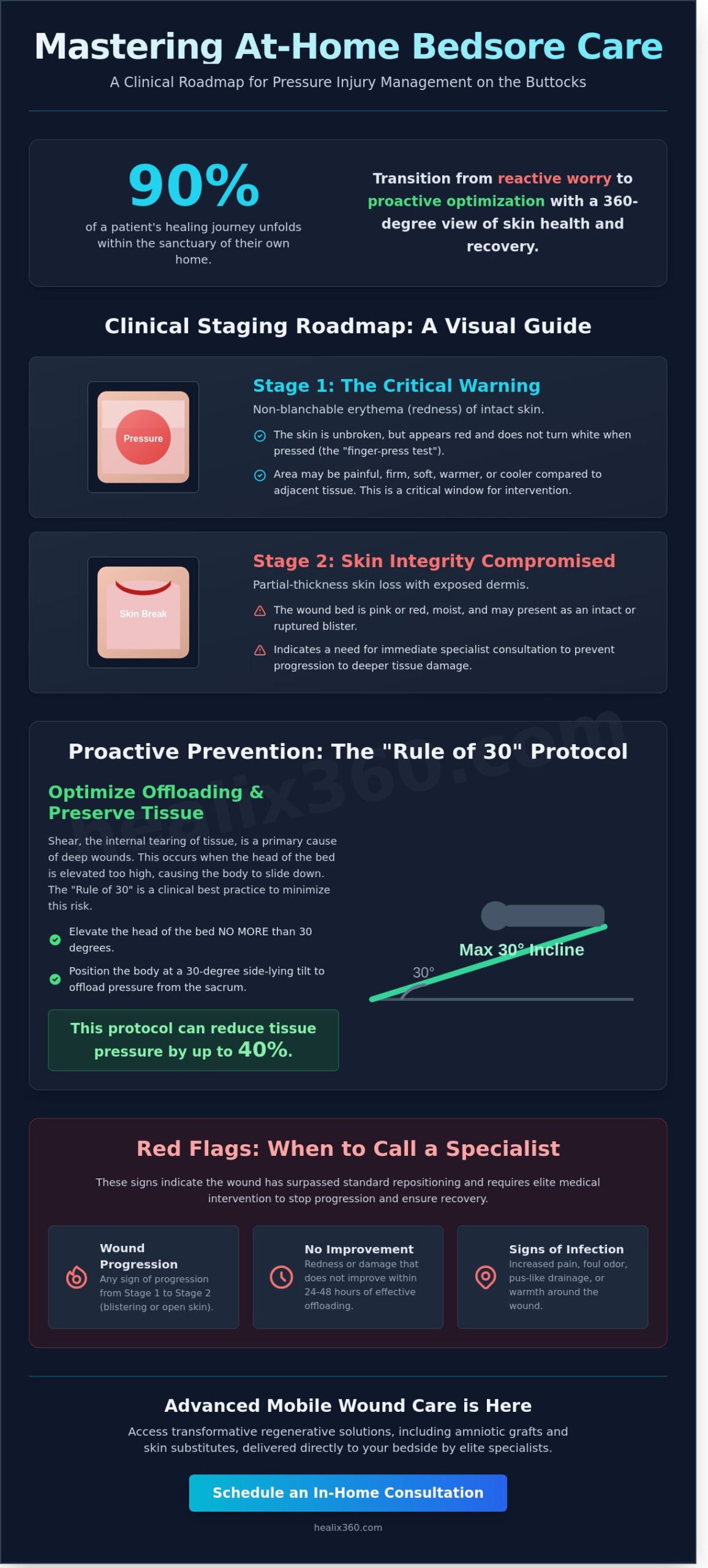
True clinical recovery doesn’t begin in a sterile hospital ward; it starts within the sanctuary of your own home, where 2025 clinical observations suggest that 90% of a patient’s healing journey actually unfolds. You understand that maintaining skin integrity is a high-stakes responsibility, particularly when Southern California’s humidity levels fluctuate or temperatures climb above 85 degrees. Managing at-home care for bedsores on buttocks often brings a sense of urgency, especially when distinguishing Stage 1 redness from a Stage 2 break. We’re here to provide the clinical clarity you need to move from a state of reactive worry to one of proactive optimization.
This guide provides the roadmap to master clinical pressure injury management while preserving your loved one’s quality of life and long-term vitality. You’ll learn how to implement precision positioning protocols that reduce tissue pressure by 40% and moisture control strategies specifically tailored for our unique coastal environment. We’ll identify the precise indicators that suggest a need for advanced regenerative intervention, ensuring you have a 360-degree view of the recovery process. You’ll feel confident in your ability to stop wound progression and access elite specialist care without ever leaving your residence.
Key Takeaways
- Gain a precise understanding of sacral anatomy and the clinical staging roadmap required to assess pressure injuries with professional accuracy.
- Implement the “Rule of 30” protocol to optimize at-home care for bedsores on buttocks, ensuring effective offloading and the preservation of tissue integrity.
- Recognize the subtle clinical markers and “red flag” symptoms that indicate when a wound has surpassed the limits of standard repositioning.
- Explore the transformative potential of mobile regenerative solutions, bringing advanced amniotic grafts and skin substitutes directly into your home environment.
- Transition from reactive wound management to a proactive recovery strategy that integrates high-tech diagnostics with elite bedside expertise.
Understanding Pressure Injuries on the Buttocks: The Sacral Anatomy
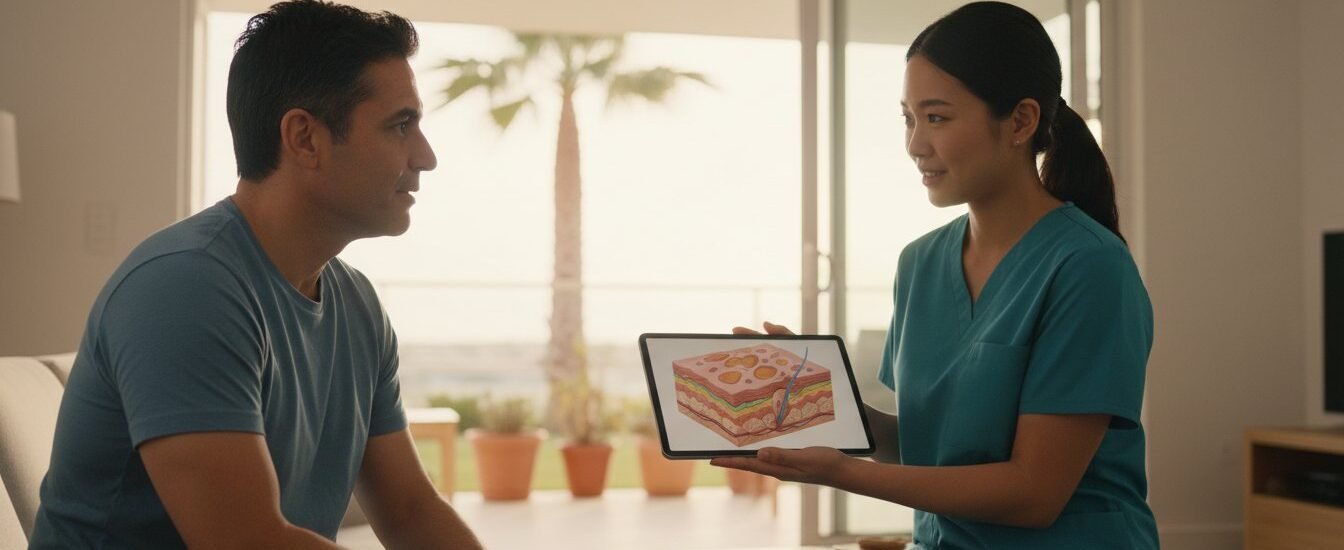
Effective at-home care for bedsores on buttocks begins with a fundamental shift in how we perceive the skin’s relationship with the skeletal structure. A pressure injury isn’t merely a surface-level irritation. It represents localized damage to the skin and underlying soft tissue, typically occurring over bony prominences like the sacrum, coccyx, and ischial tuberosities. Understanding Pressure Injuries requires recognizing that these wounds result from intense or prolonged pressure combined with shear. In the gluteal region, the proximity of bone to the surface creates a high-risk environment where tissue can be trapped and compressed, leading to rapid cell death.
At Healix360, we advocate for a 360-degree view of skin health. This methodology looks beyond the point of contact to examine the intersection of microclimate and pressure. The microclimate refers to the temperature and moisture levels at the skin-surface interface. In Southern California, where inland temperatures frequently exceed 90 degrees Fahrenheit, humidity and heat can lead to skin maceration. When skin becomes over-hydrated from perspiration or incontinence, its structural integrity weakens. This creates a gateway for moisture-associated skin damage (MASD), which often mirrors or exacerbates traditional pressure injuries.
The Role of Friction and Shear in Buttock Wounds
Shear is the silent architect of deep tissue damage. It occurs when the skin remains stationary against a surface while the underlying bone and muscle shift. This internal tug-of-war stretches and tears the delicate capillaries that supply oxygen to the tissue. In many Southern California homes, the use of plush recliners or adjustable beds can inadvertently increase shear. When a person sits at an incline greater than 30 degrees, gravity pulls the pelvis downward. This mechanical force causes internal damage long before a wound appears on the surface. Standard buttock wounds are rarely simple scrapes; they’re often the visible tip of a deeper, more complex physiological disruption.
Bio-Markers of Skin Vulnerability
Skin longevity is a cornerstone of our proactive care philosophy. As we age, collagen density in gluteal tissue decreases by approximately 1% annually, reducing the skin’s natural “bounce back” ability. We view hydration and nutrition as critical internal biomarkers for wound prevention. For instance, low serum albumin levels are frequently correlated with a 25% increase in skin breakdown risk. Maintaining at-home care for bedsores on buttocks requires optimizing these internal variables to support the body’s regenerative processes. For a broader perspective on managing these risks, you can explore our comprehensive guide to bed sores, which details our integrative approach to longevity and tissue recovery.
Staging and Assessing Bedsores at Home: A Clinical Roadmap
Precision is the cornerstone of effective wound management. When you implement at-home care for bedsores on buttocks, you must act as a vigilant observer of biological shifts. Staging isn’t merely a classification; it’s a diagnostic roadmap that dictates your intervention strategy. By adopting a 360-degree view of the skin’s integrity, you can identify microscopic changes before they escalate into systemic threats. This proactive approach ensures that your recovery plan remains aligned with the goal of long-term health optimization.
Recognizing Stage 1 and Stage 2 Injuries
The earliest sign of a pressure injury is Stage 1, characterized by non-blanchable erythema. You can confirm this by performing the finger-press test: apply firm pressure to the reddened area for three seconds; if the skin remains red and doesn’t turn white upon release, the underlying capillaries are compromised. This stage represents a critical window for intervention. If the injury progresses to Stage 2, you’ll see partial-thickness skin loss. This often looks like an open blister or a shallow, red-pink wound bed without slough. For residents in Glendale or Los Angeles, detecting a Stage 2 injury should trigger an immediate consultation with a specialist. Following professional protocols for at-home care for a pressure sore at this juncture can prevent the transition to deeper tissue involvement.
The Danger Zones: Stage 3, Stage 4, and Eschar
Advanced injuries require a sophisticated level of clinical rigor. Stage 3 involves full-thickness tissue loss where subcutaneous fat is visible, while Stage 4 extends deep enough to expose muscle, tendon, or bone. These stages carry a high risk of osteomyelitis, a bone infection that affects approximately 30% of patients with deep pressure ulcers. You must also be wary of “Unstageable” wounds, where the depth is obscured by eschar. This dead, leathery tissue acts as a biological veil, hiding the true extent of the damage. Effective at-home care for bedsores on buttocks requires recognizing that what appears on the surface often underestimates the trauma beneath.
Never attempt to remove eschar or necrotic tissue at home. Sharp debridement is a precise medical procedure that must be performed by a specialist to ensure the wound bed is optimized for healing. Integrating mobile wound care into your routine allows for expert assessment without the 25% risk of hospital-acquired infections associated with traditional clinical environments. Proactive identification of a Deep Tissue Pressure Injury (DTPI), which appears as a persistent, deep purple or maroon discoloration, is essential for maintaining longevity and peak physical health. If you’re managing complex recovery, our team can help you optimize your healing trajectory through personalized, data-driven care plans.
The Critical Balance: When to Call a Southern California Wound Specialist
Many caregivers believe that diligent repositioning is the only tool needed for recovery. While pressure relief is a cornerstone of success, relying on it alone for an established wound is a common clinical oversight. Effective at-home care for bedsores on buttocks requires a transition from passive management to active optimization. A wound specialist acts as a health architect, designing a biological environment where tissue can actually regenerate rather than just survive. You shouldn’t wait for a crisis to seek expertise; proactive intervention is the primary driver of patient longevity.
Red flags demand immediate attention. If you notice a foul or sweet odor, a sudden increase in drainage, or redness that spreads beyond the wound’s edges, the situation has likely surpassed the limits of standard home protocols. A fever or sudden mental confusion in the patient signals that a localized issue is becoming a systemic threat. These symptoms indicate that the wound’s micro-environment is compromised and requires professional calibration. Clinical debridement becomes a necessity when necrotic tissue or slough prevents the edges of the wound from closing, a process that cannot be achieved through repositioning alone.
Identifying Signs of Infection and Biofilm
Biofilm is a sophisticated, microscopic shield that bacteria build over chronic wounds. It’s invisible to the naked eye but stops standard at-home care for bedsores on buttocks from working by neutralizing topical treatments. When a wound plateaus for more than 14 days, biofilm is usually the culprit. Our specialists use bedside evaluation to detect these barriers, often utilizing wound culture and sensitivity testing. This data-driven approach ensures we aren’t just guessing at treatments but are applying targeted therapies that address the specific bacterial profile of the wound, ensuring peak performance of the body’s natural healing mechanisms.
The Risks of Delayed Professional Intervention
Ignoring the progression of a buttock wound creates a direct path to osteomyelitis, a deep bone infection, or sepsis. In L.A. County, the cost-benefit of mobile care is clear. Data from the Agency for Healthcare Research and Quality indicates that hospitalizations for pressure ulcers are among the most expensive and longest stays. Mobile specialists provide high-level debridement and diagnostic oversight in the comfort of your home, avoiding the $20,000+ price tag often associated with emergency room admissions. For patients recovering from reconstructive procedures, coordinating with surgical wound care experts ensures the surgical site remains viable and the recovery trajectory stays on track. We take a 360-degree view of the patient’s health to ensure that a single wound doesn’t compromise their overall vitality.
Step-by-Step Management for Buttock Bedsores: Clinical Best Practices
Success in at-home care for bedsores on buttocks hinges on a rigorous, daily clinical routine. We view wound management not just as a reactive necessity, but as a proactive optimization of the body’s regenerative capacity. To stabilize early-stage wounds, implement this 5-step protocol every morning:
- Visual Assessment: Utilize a high-output LED light to inspect the sacral region for subtle changes in color, texture, or temperature.
- pH-Balanced Cleansing: Use a surfactant-based cleanser with a pH of 5.5 to preserve the skin’s protective acid mantle and prevent bacterial colonization.
- Moisture Barrier Application: Apply a dimethicone-based barrier cream to the perianal area to shield tissue from moisture-associated skin damage caused by incontinence.
- Exudate Management: Evaluate the level of fluid; select specialized foam dressings for moderate drainage or hydrocolloids for dry, superficial wounds.
- Metric Tracking: Measure the wound diameter weekly using a metric ruler to ensure the healing trajectory remains positive.
Offloading is the most critical variable in this equation. The “Rule of 30” is our gold standard. This involves tilting the patient at a 30-degree angle using medical-grade wedges rather than traditional pillows. This specific degree of rotation shifts pressure away from the bony sacrum and onto the larger muscle mass of the gluteus. It prevents the capillary occlusion that leads to rapid tissue death.
Advanced Offloading Techniques for the Sacrum
Clinical data shows that “donut” cushions don’t help. They actually restrict blood flow to the center of the wound, which can increase the risk of tissue necrosis by 15%. We recommend replacing these outdated tools with high-specification pressure-redistribution mattresses. In Southern California, families can easily access low-air-loss systems that circulate air to keep the skin cool and dry. Repositioning must occur every 120 minutes. This precise rhythm ensures that cellular oxygenation levels remain high enough to support metabolic recovery.
Optimizing the Wound Micro-Environment
Modern wound science has debunked the “wet-to-dry” dressing myth. Removing a dry dressing often tears away fragile new granulation tissue, which sets the healing clock back by several days. Instead, maintain a moist environment to accelerate autolytic debridement. Nutrition is your most powerful biomarker for success. Increasing protein intake to 1.5 grams per kilogram of body weight provides the structural amino acids necessary for gluteal tissue synthesis. This integrative approach ensures the body has the raw materials required for peak performance in recovery.
Advanced Mobile Wound Care: Regenerative Solutions at Your Bedside
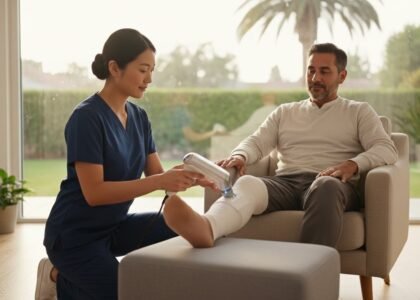
Healix360 redefines the traditional clinical boundary by delivering a comprehensive wound care center directly to your residence. This mobile model eliminates the logistical strain of transporting patients with significant mobility challenges. By integrating hospital-grade technology with personalized attention, we ensure that at-home care for bedsores on buttocks meets the highest surgical standards without the stress of a facility visit. Our specialists arrive at your door with the tools necessary to perform complex diagnostics and treatments in the comfort of your bedroom.
Effective recovery requires more than just passive monitoring. It demands proactive intervention. Our team functions as a visionary health architect, designing a recovery environment that prioritizes tissue integrity and systemic health. We bridge the gap between advanced laboratory science and the daily lived experience of the patient, ensuring that every treatment move is data-driven and results-oriented.
Regenerative Medicine and Skin Substitutes
Biological innovation has transformed the prognosis for chronic pressure injuries. These advanced skin substitutes represent a paradigm shift in wound closure for Stage 3 and Stage 4 injuries. By utilizing biological scaffolds, we provide the necessary architecture for cellular regeneration. Our specialists apply amniotic allografts during a brief, painless bedside procedure. These grafts contain essential growth factors and cytokines that jumpstart the healing process in ulcers that have failed to respond to traditional methods. Stem-cell-based therapies offer a 360-degree approach to healing, addressing the wound at a molecular level to ensure durable, long-term closure.
Accessing Care in Los Angeles, Glendale, and Beverly Hills
Healix360 operates as a strategic partner to home health agencies throughout Los Angeles, Glendale, and Beverly Hills. We coordinate directly with your existing care team to provide specialized oversight that standard home health visits might lack. Medicare Part B typically covers these mobile medical consultations and advanced procedures in Southern California, removing financial barriers to elite medical expertise. Our primary objective is to help patients avoid the downward spiral of chronic infection and hospital readmission. We focus on longevity and peak performance, even during the recovery phase.
You don’t have to manage these complex medical challenges in isolation. Family members can initiate a professional bedside evaluation today by contacting our clinical coordinators. We provide a clear, actionable roadmap for at-home care for bedsores on buttocks that focuses on rapid healing and the restoration of comfort. Our board-certified specialists arrive equipped to transform a difficult recovery into a managed, successful journey toward wellness. It’s time to choose a partner who views your health as a valuable asset worthy of the most advanced scientific care available.
- Expert Evaluation: Comprehensive assessment by board-certified wound specialists.
- Bedside Procedures: Painless application of regenerative grafts in the home.
- Seamless Coordination: Direct partnership with your current home health agency.
- Insurance Integration: Utilization of Medicare Part B for mobile specialist services.
Elevating Your Recovery with Precision Wound Architecture
Healing isn’t just about recovery; it’s about optimizing your body’s innate ability to regenerate. Effective at-home care for bedsores on buttocks requires more than basic dressings; it demands a clinical strategy that addresses the unique pressure points of the sacral region. We’ve explored how identifying early-stage indicators and maintaining the delicate moisture balance of the skin can prevent severe complications. Our board-certified wound specialists follow the latest 2026 clinical protocols to bring the hospital to your bedside, utilizing advanced regenerative grafts that accelerate tissue repair. As a Medicare Part B provider, Healix360 ensures that elite medical intervention is both accessible and seamless within your private residence.
You don’t have to navigate the complexities of wound management alone. Our team provides a 360-degree view of your health, combining scientific rigor with a human-centric approach to ensure your longevity and comfort remain the priority. Take the first step toward transformative results by partnering with experts who value your health as much as you do. Schedule a Professional Bedside Wound Evaluation in Southern California. Your journey toward peak health and skin vitality starts with a single, proactive decision today.
Frequently Asked Questions
How do I know if a bedsore on the buttocks is infected?
You can identify an infection by looking for yellow or green drainage, a foul odor, or redness spreading more than 2 centimeters from the wound edge. These clinical markers indicate a breakdown in the body’s natural defense barriers. You may also notice a localized temperature increase of 3 degrees Fahrenheit compared to surrounding skin. Monitoring these specific biomarkers allows for early intervention and prevents systemic complications that could stall your recovery journey.
Can Medicare cover at-home wound care visits in Southern California?
Medicare Part B typically covers 80 percent of the cost for medically necessary at-home wound care visits when provided by a certified professional. In Southern California, residents must meet specific homebound criteria as defined by the Centers for Medicare & Medicaid Services (CMS). This coverage ensures you receive integrative medical support in your private environment. Our team helps you navigate these regulatory requirements to optimize your personalized care plan for long-term health.
What is the best position to sleep in to avoid pressure on the sacrum?
The 30-degree lateral tilt is the most effective position to eliminate direct pressure on your sacrum and buttocks. You achieve this by using pillows to prop your body at a 30-degree angle rather than lying directly on your side. This specific alignment preserves micro-circulation in vulnerable tissues. It’s a foundational step in at-home care for bedsores on buttocks, ensuring your skin remains oxygenated throughout the night for peak performance.
How long does it take for a Stage 2 bedsore on the buttocks to heal?
A Stage 2 bedsore typically requires 1 to 6 weeks to achieve complete closure under optimal conditions. Healing involves the regeneration of the epidermal layer and the stabilization of the underlying dermis. If you don’t see visible progress within 14 days, it’s time to re-evaluate your moisture management or pressure relief protocols. We focus on accelerating this timeline through data-driven strategies that support your body’s innate regenerative capacity.
Should I use antibiotic ointment on a pressure sore at home?
You should only use antibiotic ointments if a clinician identifies a localized infection through a formal wound culture. Overusing these products can lead to bacterial resistance and may actually macerate the healthy skin surrounding the sore. Instead, focus on advanced dressings that maintain a 360-degree moist environment. This professional approach to at-home care for bedsores on buttocks prioritizes the delicate balance of your skin’s microbiome for faster healing.
What is the difference between a pressure sore and a moisture rash on the buttocks?
A pressure sore typically appears over a bony prominence like the tailbone, while a moisture rash often shows up in skin folds as diffuse redness. Pressure injuries result from vertical force that restricts blood flow, whereas moisture-associated skin damage (MASD) stems from prolonged exposure to irritants like perspiration or urine. Distinguishing between these two is vital. We use precise diagnostic insights to ensure your treatment targets the root cause rather than just surface symptoms.
When is surgical debridement necessary for a bedsore?
Surgical debridement becomes necessary when Stage 3 or 4 wounds contain more than 25 percent necrotic tissue or slough. This procedure removes non-viable material that acts as a reservoir for bacteria and prevents the formation of healthy granulation tissue. It’s a proactive step that resets the wound’s biological clock. By clearing this debris, we create a clean slate for advanced therapies to take hold and drive your recovery forward.
How do amniotic grafts help heal deep bedsores faster?
Amniotic grafts accelerate healing by delivering over 200 growth factors and essential cytokines directly to the wound bed. These biological scaffolds provide a 360-degree regenerative matrix that encourages rapid cell migration and tissue remodeling. Clinical studies show these grafts can reduce healing time by 40 percent in complex chronic wounds. Integrating this high-tech solution into your plan transforms a stagnant injury into a dynamic site of cellular optimization.